
Categories
Business Insurance News

Two of Our Leaders Named in Insurance Business Asia-Pacific Elite Women 2026

We are incredibly proud to share that two of our senior leaders have been recognised in the Insurance Business Asia-Pacific Elite Women 2026 list, one of the most prestigious acknowledgements of female leadership in the insurance industry across the region.

This year, 70 women across Asia, Australia and New Zealand were named from a field of nominees assessed on leadership impact, influence, innovation and commitment to progress. To have two leaders recognised from our organisation is something we don’t take lightly.

A Big Moment for a Small but Mighty Team

We are a collection of businesses spanning insurance, underwriting, SaaS and premium funding and we turned 40 last year. For a team of just over 40 people, having two leaders named on a list of this calibre is, frankly, a big deal. And we’re going to own that.

Rebecca: Driving Strategy and Technical Excellence

Rebecca, our Chief Insurance Officer, has been instrumental in shaping the technical and strategic heart of our business. She brings deep insurance expertise and a forward-thinking approach to everything she touches and her seat on the Women in Insurance board reflects a commitment to the industry that extends well beyond our four walls.

Kate: Building a Culture Designed to Thrive

Kate, our Chief People Officer, joined with a rich background in diversity, equity and inclusion and has been a driving force behind building a workforce that is genuinely designed to thrive. Not by accident but by design.

Transforming the Business from the Inside Out

What makes this recognition particularly meaningful is what it represents about the way these two leaders have worked together. Over the past year, Rebecca and Kate have collaborated to reshape how our organisation operates from the inside out by building the team by design and redesigning team structures, shifting the focus from presence to output, embedding a values-driven culture, and overhauling the systems our people use every day.

The Results Speak for Themselves

The results speak for themselves: employee turnover reduced by 80%.

Read that again. Eighty percent.

In an era where talent retention is one of the greatest challenges facing businesses of every size, that number is extraordinary and it didn’t happen by chance. It happened because two leaders decided that engagement, culture and people-first thinking weren’t soft initiatives. They were a business strategy.

Building the Future of Work

As we look ahead, our focus continues to evolve. We are actively exploring how AI and emerging technologies can be integrated into our workforce ecosystem in ways that support our people to stay engaged, energised and not overwhelmed. The future of work is something we’re building intentionally, not reacting to.

Looking Ahead with Pride

We are proud of Rebecca and Kate. We are proud of the team that surrounds them. And we are proud to be the kind of organisation, at 40 years young, that still has the appetite to do things differently.

Congratulations to all 70 Elite Women recognised across Asia-Pacific this year. You can read the full report via Insurance Business Asia-Pacific.

Categories
Business Cyber Insurance Insurance Insurance Insights

Protecting Your Business With Cyber Risk Management

Cyber risk is one of the most common threats for Australian businesses. It can disrupt operations and cause serious losses.

To help businesses, the Australian Government released the Essential Eight. This is a set of eight practical cybersecurity strategies. They are designed to help businesses get back to trading quickly after a cyber incident.

Essential Eight Cybersecurity Strategies

The Essential Eight encourages businesses to:

1.Keep software up to date: Regularly update your operating systems and applications to close security gaps.

2. Control access: Only allow authorised staff to make important system changes. Remove access when staff leave.

3. Use strong passwords and MFA: Strong passwords plus multi-factor authentication (MFA) add an extra layer of protection.

4. Limit risky programs: Block or restrict applications and macros that are commonly used to spread malware.

5. Back up data often: Make frequent, secure backups. Test them to make sure you can restore data quickly.

6. Protect against phishing and unsafe sites: Reduce risk from malicious emails and dangerous websites.

7. Have a simple response plan: Know what steps to take and who to contact if something goes wrong.

8. Educate your staff: .Use monthly updates from the Essential Eight team to keep staff aware of the latest cyber threats.

Australian business protecting against cyber risk with Essential Eight cybersecurity strategies

Why Cyber Risk Management Matters

Insurers now look closely at cyber risk management when deciding coverage, premiums, and claims for Australian businesses. Businesses that follow frameworks like the Essential Eight are better prepared if a claim occurs.

Demonstrating these controls can also help negotiate stronger coverage or lower premiums.

What You Should Do?

If you’re reviewing your insurance or risk management, now is a good time to consider how the Essential Eight cybersecurity strategies could be implemented in your business. Contact your broker to discuss these controls in detail.

Categories
Business Claims Insurance Insurance Insights

When One Accident Put a Business on Pause, We Helped Get It Back on Track

For small business owners, work is more than just work. It is your livelihood. So when something unexpected stops you from working, the stress can be huge. This is where strong insurance claims support makes a real difference.

One of our clients in the commercial cleaning industry experienced this when their work vehicle was damaged in an accident. With jobs booked and bills to pay, being off the road was not just inconvenient. It caused real financial pressure.

The client had a Downtime benefit in their insurance policy, also known as business downtime insurance. This benefit is designed to provide income support while a vehicle is being repaired. After the breakdown, the client lodged a claim and received a repair quote that was below their insurance excess. They decided to pay for the repair privately to avoid the excess.

Partway through the repair, the mechanic found more damage. The new quote was now higher than the insurance excess. Because of this, the client chose to have the repair covered by insurance instead.

The insurer approved the repair costs. However, they declined the Downtime benefit. They relied on a policy exclusion because the first repairs had been done privately.

Our role

Our claims team stepped in to provide dedicated insurance claims support during this stressful time. We reviewed the situation and challenged the insurer’s decision. We explained that:

  • Any reasonable person would have made the same choice
  • The client acted in good faith and did not try to mislead
  • The insurer suffered no additional financial loss from the client going ahead with repairs

We kept the client informed at every step. We reassured them and handled the discussions with the insurer so they could focus on running their business. This is an example of strong insurance broker claims advocacy in action.

Small business owner affected by vehicle breakdown during insurance claim

The outcome

Because of our team’s experience and persistence, the insurer agreed to pay the maximum Downtime benefit under the client’s business downtime insurance. The client received the income support they needed during a difficult period. This reduced financial pressure and helped them return to work with confidence.

Key takeaways:

This claim shows why working with an insurance broker matters:

  • Policy wording is not always final, and insurers must follow a fair claims process
  • Experienced claims support can challenge insurer decisions
  • Brokers provide insurance broker claims advocacy in complex situations
  • You don’t have to navigate claims alone

Insurance is about being there when it counts and we’re proud to stand beside our clients when they need it most.

Claims contact information

1800 809 132 (choose option 1 for claims)
claims@eastwest.com.au

Categories
Business Cyber Insurance Insurance Insurance Insights

AI in Business: Powerful Tool, New Exposures

Artificial Intelligence in business is now part of everyday operations. It helps with admin tasks, data analysis, and customer service. It can also help write messages and emails. AI is a useful tool for saving time and improving efficiency.

For many businesses, using AI is no longer a choice. It is becoming necessary to stay competitive. But every new tool brings new risks, therefore, it is important to understand these risks before relying on AI.

Understanding AI

A simple way to think about AI is to compare it to your home. A robot vacuum or dishwasher can save you time. But they only work well if the space is set up properly. If there are items on the floor, blocked pipes, or the machine is too full, problems can happen.

AI works in the same way.

The more AI is used in your business, the more important it is to control how it is used. You will need to manage what it can access and who is responsible for it.

Without clear rules and controls, businesses may face challenges. Effective AI risk management can help reduce:
  • Data privacy and confidentiality breaches
  • Cyber attacks or system failures
  • Incorrect results or false information
  • Intellectual property or copyright problems
  • Legal or regulatory issues
Artificial intelligence in business: Insurance to manage AI risks

The Role of Business Insurance for AI

From an insurance point of view, protection must keep up with new technology.

Many insurance policies do not clearly cover AI-related problems. This is common when data, cyber risk, or professional advice is involved. Just as you protect your home and contents, you should also protect your business. This means checking your insurance regularly and making sure your coverage matches how your business uses technology, including AI.

Keeping Business Efficient and Protected

AI can make running your business easier and faster. The key is to set it up properly and ensure you have the right protection in place.

If your business is starting to use new technology or is expanding its use of AI, now is the time to talk to your broker. A review of your risk management and insurance cover, including AI risk management strategies will help make sure your protection grows with your business.

Categories
Business Insurance

Commercial Property Insurance: Why Purchase Price Doesn’t Equal Sum Insured

When arranging insurance for a commercial property, many owners make a common mistake: using the purchase price as the sum insured.

On the surface, it feels logical. If that’s what you paid for the property, surely that’s what it’s worth? However, the purchase price doesn’t always reflect the actual cost of rebuilding.

Purchase Price vs. Rebuild Value

It’s important to understand the difference between the purchase price and rebuild value when it comes time to insuring your property. Yes, both relate to what your property is worth, but they represent and serve very different things.

Purchase Price

The purchase price of a property represents the total amount paid to acquire it on the market. It’s affected by several factors, which include:

  • The value of the land.
  • The property’s location and market demand.
  • Broader economic conditions at the time of purchase.

None of these is relevant to an insurer if your building is damaged or destroyed. Insurance is about replacing the structure itself, not the land it sits on.

Rebuild Value

The sum insured is generally expected to reflect the full replacement value of the building, which includes:

  • Demolition and debris removal.
  • Professional fees (engineers, architects, surveyors).
  • Current labour and material costs.
  • Compliance upgrades (to meet today’s building codes).

What’s the difference?

The key difference between purchase price and rebuild value lies in what each represents. The purchase price reflects the property’s market value, including the land, location, and broader economic factors, while the rebuild value focuses solely on the cost to reconstruct the building if it were damaged or destroyed. This includes demolition, debris removal, professional fees, materials, labour, and any upgrades needed to meet current building codes. In short, insurance covers the cost to rebuild, not the market price you paid.

The cost of getting it wrong

If your sum insured is based on the purchase price rather than a professional valuation, you risk being underinsured. And underinsurance doesn’t just affect you in the event of a total loss. It can also reduce your payout even in the case of a partial claim. For example:

  • A property was purchased for $2 million, but the actual rebuild cost is $3 million
  • The sum insured is set at $2 million (instead of $3 million).
  • A fire causes $600,000 worth of damage
  • Because the building was underinsured by one-third, the insurer may pay only two-thirds of the claim (about $400,000)

This could leave you, the owner, with $200,000 out of pocket expenses even though the damage wasn’t a total loss.

professional property valuations matter to help you determine the right cost to insure your property for

Why professional property valuations matter

Construction costs in Australia have surged in recent years, driven by shortages of materials and skilled labour. Without a proper valuation, it’s easy to underestimate the cost of rebuilding today compared to when you purchased the property. A professional building valuation gives you:

  • Confidence that your sums insured are accurate
  • Protection from co-insurance penalties
  • Peace of mind that your biggest asset is covered correctly

It’s best to arrange a professional building valuation every few years and review your insurance sums annually. That way, your cover keeps pace with any changes to your property, as well as rising rebuild costs and inflation.

Avoid underinsurance with proper valuation

The purchase price reflects market conditions, not rebuilding costs. Having a commercial property is already a significant investment, and underinsurance can create unexpected financial strain during claims. To safeguard your investment, arrange a professional building valuation and review it regularly. That way, your insurance truly reflects today’s replacement costs, not yesterday’s market value.

When it comes to protecting your assets and ensuring the sums are properly accounted for, a Broker would be a huge help. If you want advice or are interested in learning about available options for commercial property coverage, reach out to East West Insurance Brokers today.

Categories
Business Insurance

How Underinsurance Can Hurt Even in Partial Claims

When you think of business insurance, you probably imagine it kicking in after a total disaster, like a fire that levels your building or a car that’s completely written off. But what many business and property owners don’t realise is that even if your loss is only partial, being underinsured can leave you with serious financial strain. Shortfalls in coverage can hurt so you need to be prepared before it’s too late.

What Is Underinsurance?

Underinsurance happens when the sum insured on your policy is less than the true replacement or repair cost of your asset. In other words, you’re insured for less than what it would actually cost to rebuild, repair, or replace. It’s surprisingly common especially with the rising construction costs and inflation. So, if you’re not regularly reviewing your cover, this can also leave you underinsured and underprepared.

The 80% Co-Insurance Rule in Australia

In Australia, most commercial property and business insurance policies include a co-insurance (or average) clause set at 80% of the asset’s replacement value.

What this means:
  • If you insure your asset for at least 80% of its true value, the insurer will generally pay the full amount of any loss (up to the sum insured).
  • If you insure for less than 80%, the insurer can reduce the claim proportionally even if the loss is only partial.
Example:
  • True Building Value: $1,000,000
  • Minimum Cover Required (80%): $800,000
  • Insurance Purchased: $600,000 (60% of true value)
  • Loss: $200,000
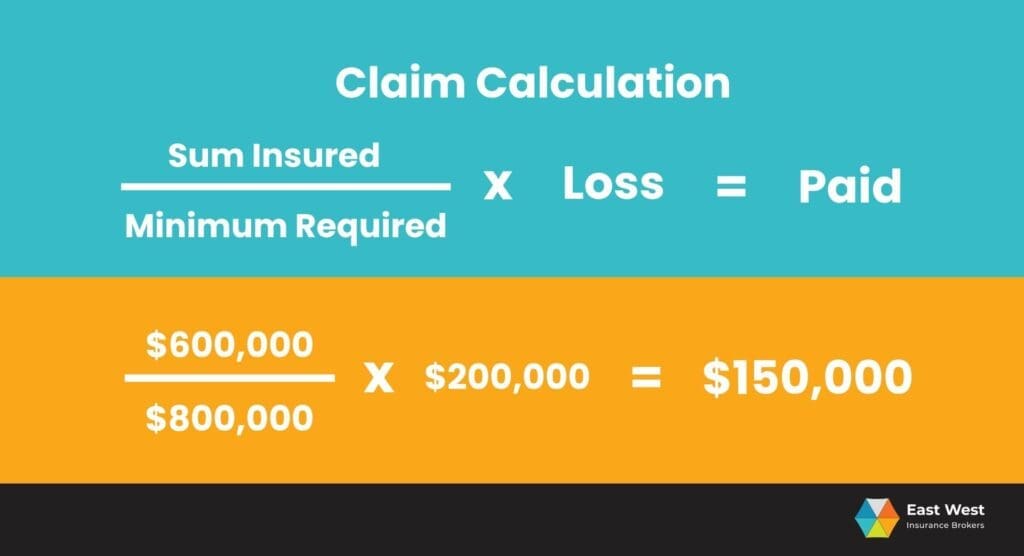
  • Claim Calculation: (Sum Insured / Minimum Required) X Loss
Example of a claim calculation.

That would be [($600,000 / $800,000) X $200,000] $150,000 paid. Even though the damage was only partial, you’d be $50,000 out of pocket because of underinsurance.

The real-world Impact of underinsurance

  • Unexpected repair bills – You may have to fund a large portion of repairs yourself.
  • Cash flow pressure – Reduced payouts can strain your business finances.
  • Delayed recovery – With less money to repair or replace assets, recovery takes longer.
  • Business risk – In some cases, underinsurance can threaten not just your return to business, but also your overall ability to keep operating.

How to avoid underinsurance

  1. Get regular valuations – Ensure your building, plant, and equipment values reflect today’s replacement costs.
  2. Factor in inflation – Materials and labour costs rise quickly; your insurance should keep pace.
  3. Review sums insured annually – Don’t just renew “as is” each year.
  4. Work with an Insurance Broker – They understand co-insurance clauses and can explain how it will affect you.

Insurance should offer peace of mind, not unpleasant surprises

You take out insurance for security, not for shock and disappointment. But if your cover is less than 80% of the true replacement value, even a partial loss can leave you with a reduced payout.

So, don’t take the risk. Review your business insurance cover with a Broker. They can even recommend professional valuers to ensure your sums insured are accurate to help you avoid the risk of underinsurance.

If you’d like the support, the team at East West Insurance Brokers is ready to help you perform a review and make sure you’re properly protected.

Categories
Business Construction Insurance Insurance

How Property Valuation Affects Commercial Property Insurance

What do a cozy cafe, a small retail shop, and a towering office building have in common? They all face similar risks when it comes to protecting their property. From fires and floods to theft and vandalism, these unexpected events can disrupt operations—or even force a business to shut down entirely.

That’s why having appropriate commercial property insurance is important. Whether you own or lease your space, your insurance can be the lifeline safeguarding your business from financial fallout.

But before you start insurance shopping, you should first get your commercial property professionally valued.

What is a property valuation?

The estimated market value of a property, which a qualified professional appraiser usually performs. This assessment is based on various factors, which include:

  • Condition of the property
  • Existing structures
  • Location and proximity to other facilities
  • Market trends
  • Renovations and upgrades
  • Size and layout
  • Valuation of similar properties within the area

There are two main types of property valuations, each serving different purposes. Understanding the distinction between them is crucial to avoid costly mistakes.

  1. Real estate valuation – Used for buying, selling, or securing a mortgage. This type of valuation assesses a property’s sale value, which is influenced by current market trends.
  2. Insurance valuation – Used in insurance applications. It focuses on the cost of rebuilding or repairing a property based on current construction costs.

Insurance valuations are sometimes calculated using a $ per square metre estimate. However, general property valuers may not be qualified to quote rebuild costs. To ensure you’re not underinsured, it’s recommended to consult a surveyor for a more accurate figure.

It’s also important to remember that real estate and insurance valuations can differ significantly, sometimes in millions, and should not be used interchangeably.

Properties in prime location with plenty of foot traffic will also be valued higher.

How can property valuation impact insurance?

Insurers may use the property valuation report to determine what coverage is necessary and calculate the total cost of the premiums they’ll offer. A higher property value can mean more payouts are required in the event of a repair or replacement claim, leading to higher premiums. On the other hand, they may offer lower premiums to properties with lower value. The catch is this may mean less coverage and more out-of-pocket costs in case of a claim.

You need an accurate property valuation to balance adequate coverage and manageable premiums. This would help you avoid the following:

Over-insuring

Securing as much coverage as possible may sound like the safer option. However, insurers typically don’t pay more than the actual repair cost or the property’s market value. If your property is overvalued, this might lead to over-insuring and paying higher premiums for coverage you may not even need.

Underinsuring

Undervaluing your commercial property to pay lower premiums may sound like an easy way to save money, but it won’t help your business long-term. You may end up exposed to the risk of being underinsured in the event of a claim. Payouts from insurers may not cover enough repair or replacement costs, leading to additional financial strain.

Penalty fees

Policies may include a ‘co-insurance’ clause, which requires the property to be insured to a certain percentage of its value. If your property is found to have been undervalued, your insurance company may penalise you with a penalty fee or reduce the payout in the event of a claim.

Legal issues

An inaccurate commercial property valuation may also violate contractual agreements for leasing and mortgage.

Learn more about commercial property insurance by contacting East West Insurance Brokers.

Insurance property valuation determines the premiums you'll need to pay.

How else can I benefit from property valuation?

It’s advisable to have your property professionally revalued every few years or whenever significant changes occur, such as renovations, expansions, or shifts in the local market. This helps you and your insurance provider update your coverage to match your business needs.

Having accurate and up-to-date valuation also minimises disputes during claims because insurers are better equipped to assess losses accurately, ensuring a smoother claims process.

Secure your commercial property

Having an accurate and up-to-date property valuation empowers you to make smart financial decisions while ensuring you have adequate insurance coverage to protect your investment. In business, preparation is everything—and staying ahead begins with understanding the true value of what you own.

Want to learn more about commercial property insurance? Connect with East West Insurance Brokers! Our team of expert insurance brokers can provide valuable insights into commercial property coverage for you and your business. Contact us today to get started!

Categories
Business Construction Insurance Insurance

Australia’s Welding Industry: Trends Driving Growth and Opportunity

The future of the global welding industry looks bright. As demand from sectors like automotive, construction, and heavy engineering continues to rise, the industry’s value is projected to grow from USD 24.73 billion in 2023 to USD 34.18 billion by 2030. Australia is poised to be a key player in this exciting transformation. But what developments are in store for the welding industry?

Increasing Demand for Skilled Welders

By 2030, we will be 70,000 welders short“, according to Geoff Crittenden, chief executive of Weld Australia. It’s an issue faced by other countries, such as the United States and Japan.

While the worker shortage can mean more employment opportunities for aspiring welders, given the numerous ongoing infrastructure and expansion projects, there is a pressing need to address it now. As a result, the Australian government is encouraging more investment in the welding industry by funding businesses and nurturing the talent pool through various programs.

Promoting Diversity in Trades

Women make up 48% of the country’s workforce. However, less than 1% in the welding and fabrication sector are women. Part of addressing the worker shortage is taking a proactive approach to promoting opportunities for women. In 2022, the Victoria government launched the Building Equality Policy to support women in getting into male-dominated industries. More projects are also being funded to encourage other underrepresented groups to enter trades and STEM training.

Skilled Migration Program

Australia is also looking to address the labour shortage with the Skilled Migration Program, which reopened in October 2023 with new criteria. The government has streamlined the visa process to help experienced and skilled tradespeople from overseas apply for jobs in Australia. This helps fill vacant positions and fosters regional development by introducing global talents.

The welding industry is evolving with new technologies

Innovation Through Technological Advancements

As demand grows, technology advances to cope, and the welding industry is no exception. The launch of Industry 4.0 last year has given a boost by pushing for the integration of digital technologies like AI, Internet of Things (IoT), and robotics. These have dramatically enhanced productivity while supporting Australia’s sustainability efforts by promoting energy-efficient practices. Here are just some examples:

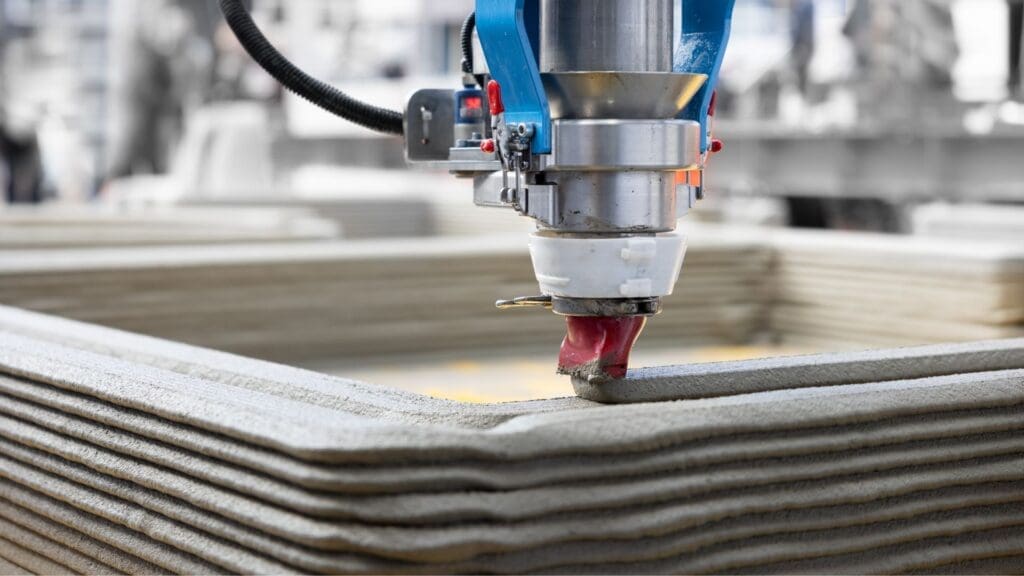
  • 3D printing – Allows for the rapid creation of prototypes and complex components, unlocking new design possibilities while minimising waste during the design phase.
  • Internet of Things (IoT) – Utilises real-time data reporting to enable predictive maintenance, helping reduce downtime and enhancing operational efficiency during critical issues.
  • Robotic and laser welding – Transforms traditional welding practices by enhancing precision and quality, creating new opportunities for businesses to optimise and deliver superior results.
Australia is switching to more renewable sources of energy, pushing the welding industry to adapt.

Switching to Renewable Energy

35% of the total electricity generated in Australia last year was from renewable energy sources. It’s only expected to rise in the following years as the country ramps up efforts to transition to greener energy sources as part of the nationwide goal of reaching net-zero carbon emissions by 2050. Multiple legislation and projects have been introduced to boost support.

Capacity Investment Scheme

First introduced in December 2022 and then expanded in November 2023, the Capacity Investment Scheme aims to unlock $40 billion in private investment into the local manufacturing industry to create more jobs and improve local economic participation in the renewable energy transition.

Future Made in Australia Act

One such effort is the Future Made in Australia Act, a major piece of legislation passed in 2021. Under this, the Australian government commits to providing funding and incentives for businesses to invest in manufacturing capabilities and to adopt cleaner technologies. It aims to make the country’s economy more sustainable, increasing the resilience of supply chains and boosting the manufacturing industry’s ability to compete globally.

State Prosperity Project

The South Australian Government also launched the State Prosperity Project early this year to reindustrialise the Upper Spencer Gulf by harnessing its mineral resources, renewable energy, and green manufacturing potential. The project is in partnership with education and training providers like the Technical College in Port Augusta, opening in 2025. This college will adopt a part-time operation model, offering industry training and work opportunities across the region.

Evolve with the Welding Industry

As the welding market evolves and unveils new opportunities for innovation, you need to continue learning and enhancing your skill set. Stay alert to new trends so you can embrace them and secure a stronger competitive edge. You also need to be aware of any potential risks you’ll face in the industry.

Safeguard your journey with East West Insurance Brokers. Our team of insurance experts will guide you through your insurance options, empowering you to make informed decisions to protect your business.

Visit our website today to request a quote so you can confidently forge ahead!

Categories
Business Construction Insurance Insurance

A guide to safeguarding your retail business

Retail businesses face more unique challenges today when it comes to security. Threats are not only limited to physical damages and losses. With more people relying on digital transactions, online threats are ever-changing and can even be more damaging.

In this blog, we’ll discuss security strategies you can implement to safeguard your retail business. From offline to online, we’ve got you covered!

Physical Security

Plan store layout with security in mind

A well-designed store layout can do wonders for business growth. Customer experience can be improved by making it easier to find things they might like or need. You can boost sales by highlighting marketable or high-priced items. It can also improve your store’s security by deterring theft and intruders.

A good theft prevention strategy is reducing blind spots would-be thieves could exploit. You can do this by strategically placing shelves and installing mirrors between the aisles. This makes it easier for store employees to monitor customers and send alerts in case of emergencies. It’s also recommended to place higher-priced products near where employees can keep a close watch, preferably far from any exits.

Install surveillance and alarm systems

Ensuring complete visibility within a store is hard, and employees can’t keep an eye on everything at all times, so integrate surveillance and alarm systems in your store. Install security cameras near any entrances or exits, parking areas, and cashier stations. You can prop them up so they’re more visible and act as a deterrent. However, the more visible your cameras are, the easier they can be to avoid or destroy during a break-in.

For additional security, consider installing motion detectors with lights and alert systems to scare off potential intruders. Installing glass break sensors for windows and displays is also recommended.

Control access

Limit access to areas like stockrooms, offices, and surveillance rooms. Most stores have passcodes which can be easy to set up but also be easy to bypass. To enhance your store security, consider implementing key card systems or biometric scanners with secure locks to effectively control access and ensure that only authorised personnel can enter these areas.

Provide secure payment options.

Cybersecurity

Protect sensitive digital information with data encryption

As a retail business, customers often share sensitive information like their names, addresses, phone numbers, and credit card details. If this information falls into the wrong hands, it could damage your business and pose a threat to your customers’ personal security. Improve your digital security by implementing end-to-end data encryption.

Provide secure payment processing

One of the most common times that’s prone to data theft is during payment processing for digital wallets and cards. Vet third-party payment vendors. Perform comprehensive research on their background and customer feedback.

Perform checks and updates regularly

Don’t be complacent after installing cybersecurity measures. Stay vigilant and frequently check every software or security system to ensure it’s always up to date. This will help you detect abnormal activities, malware, and potential security breaches.

Train employees in identifying and preventing theft to improve store security

Employee Training

Train for identifying and preventing theft

Your employees are your greatest asset and, with proper training, can be very helpful in improving store security. Encourage vigilance and regular checks. Provide training on identifying suspicious behaviour, learning theft prevention strategies, and implementing store security policies.

Cyber threats can also target your employees so it’s important to provide comprehensive training on how to handle sensitive information, including customer data and payment details.

Perform regular audits

Besides regularly performing cybersecurity checks, it’s also important to perform regular audits on your store’s physical inventory. This helps ensure accurate stock levels and identify discrepancies early. Regular inventory checks are also a good theft prevention strategy by encouraging employees to be accountable.

Insurance

General Liability Insurance

Having General Liability Insurance provides added financial security by protecting your business against claims of personal injuries, property damage, or loss within store premises. For example, if a customer is pickpocketed inside your store or injured in the parking lot and then accuses the store of negligence, General Liability Insurance may help cover repair and legal costs.

Commercial Property Insurance

Commercial Property Insurance, like General Liability, can cover repair and legal costs. The difference is that it can provide coverage for losses directly suffered by the store from incidents like property damage, inventory theft, and equipment breakdown.

There are many factors and risks that you need to consider, so it’s best to speak with an insurance broker. You can contact East West Insurance Brokers to submit an inquiry and receive more information.

Business Interruption Insurance

Unforeseen circumstances and emergencies can cause significant financial damage to retail businesses, so Business Interruption Insurance is necessary. Depending on the coverage you include, it can cover loss of income, ongoing expenses during repairs, and even temporary relocation costs.

Secure your retail business with appropriate coverage

Want to find appropriate coverage for retail business insurance but don’t know where to start? Our East West Insurance Brokers team is ready to help you explore your options to protect your business. Get in touch and secure your future with us today!

Categories
Business Construction Insurance Insurance

Common Mistakes Made When Purchasing Business Interruption Insurance

The business world can be unpredictable, and even minor events can disrupt daily operations and affect your profits. That’s why having Business Interruption Insurance is critical to a solid risk management strategy. But what is Business Interruption Insurance, and how can you ensure you have the appropriate coverage for your business’s needs?

Business interruption insurance can help mitigate loss of income.

What is Business Interruption Insurance?

Business Interruption Insurance covers lost business income or profits and operating expenses when the business cannot operate as usual. Incidents may include natural disasters and when a facility or equipment sustains damage. However, Business Interruption Insurance works differently from Property and Equipment Insurance. Rather than providing cover for property repair or replacement costs, business interruption aims to cover the loss of income to the business due to the damage sustained or equipment breakdown.

Examples of Benefits and Coverage

Various benefits and specialised coverage areas are needed to maintain financial stability and reduce the damage caused by disruption to business operations. Here are some common examples of the benefits and what the insurance typically covers:

  • Income loss (calculated based on previous financial statements)
  • Operating expenses (utility bills, property rent, other fixed costs)
  • Employee wages (may include benefits and training costs)
  • Tax and loan payments
  • Additional expenses (relocation, equipment repair or rental)

Specific exclusions and constraints can be added to the insurance policies that you must watch out for. It’s ideal to routinely review coverage details to avoid surprises when an incident occurs. You also need to check for other coverage that may be required depending on the nature of your business and service. Contact East West Insurance Brokers to explore your options and find the insurance that suits your business.

Common Mistakes and How to Avoid Them

Underestimating coverage needs and costs

A common oversight many business owners make is underestimating the full impact of operational interruptions and focusing solely on lost revenue. When evaluating Business Interruption Insurance, consider the entire spectrum of operational costs, from daily expenses, employee wages and benefits to supply-related expenditures.

Where your business is located and what type of industry you’re in plays a vital role in determining the necessary coverage and premium costs. Those operating in high-risk areas and industries require even more comprehensive coverage. Properly assessing these elements when selecting your policy helps ensure your business remains resilient despite unexpected challenges.

Failing to review and update insurance policy terms and conditions

Business Interruption Insurance policies vary regarding coverage, limits, and exclusions. Before signing the dotted line, it’s essential to review the insurance policy terms and conditions to ensure it meets your business’s specific needs. Pay close attention to factors such as the waiting period before coverage kicks in, the length of coverage, benefit period, and any limitations on coverage for specific events.

Remember to review current insurance coverage regularly after signing, too. Always take a proactive approach and stay informed about your policy details. It can help you identify any necessary updates or adjustments as your business grows and evolves.

Prevention of access is a specialised coverage under business interruption insurance

Not considering additional or specialised coverage

Each business is unique, with specific challenges and requirements shaped by its industry, location, and operational scope. Part of a good risk management strategy should be evaluating the additional or specialised coverage and integrating custom insurance solutions. So, consider the following:

Prevention of Access (PA)

Many unforeseen events can disrupt business operations, from natural disasters to other dangerous situations. These may prevent you from operating your business and even restrict access to your premises by a legal authority ordering the evacuation of the public. This is where Prevention of Access comes in. It’s a specialised type of coverage under Business Interruption Insurance that protects against loss resulting from interruption of, or interference with, your business as a result of damage or threat of damage to property in the vicinity of the premises covered by the policy.

Suppliers and/or Customers Premises (SCP)

SCP is a specialised type of coverage that aims to protect businesses from financial losses resulting from property damage or loss at specified suppliers’ or customers’ premises. Suppose a manufacturing company faces significant delays and income loss due to a key supplier’s failure to deliver the necessary components in production following an insured event at their location, SCP can help mitigate the loss. On the other end of the supply chain, if your business relies on revenue from major customers who cannot complete their purchases due to property damage at their own premises, you can file a claim to minimise your losses.

Public Utilities Extension (PUE)

While SCP protects against issues with third-party businesses in the supply chain, PUE is related to utility providers. It mitigates financial instability when utility services fail and disrupt normal operations as a consequence of damage to any land-based property anywhere in Australia or New Zealand. This includes incidents involving any utility company producing, transmitting, supplying or delivering electricity, gas, water, sewerage or communication products or services used by the business. Companies in manufacturing, hospitality, and IT can significantly benefit from PUE.

Inaccurate or improper documentation

If you’re filing an insurance claim for loss of revenue, proper documentation is critical to ensuring that you receive the full benefits of your Business Interruption Insurance policy. Keeping detailed records of your finances and any communication with your insurance provider also reduces the likelihood of being denied.

Seek advice from a professional

Avoid making these common mistakes. Discover how to calculate your Business Interruption Insurance and get a reliable estimate. Seek advice from a professional insurance broker to ensure your business is covered as effectively as possible.

East West Insurance Brokers can assist you in evaluating your business’s requirements and comparing coverage options from multiple providers. Our team of experienced Insurance Advisors will provide valuable insight as you navigate different policies’ various terms and conditions. Get in touch with us today and get insured.