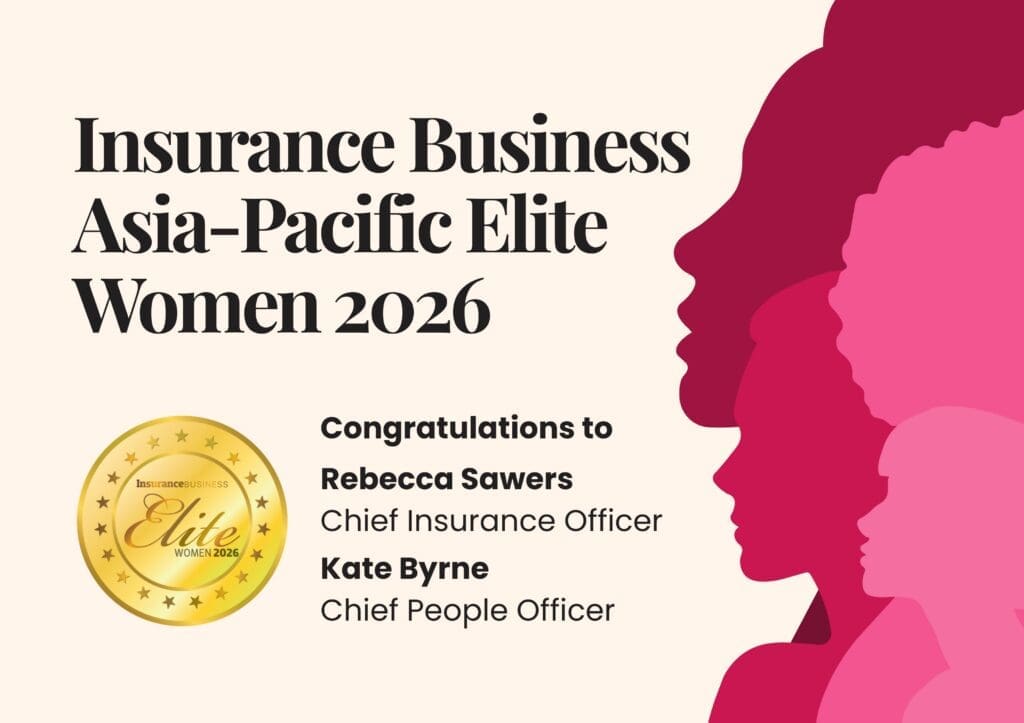
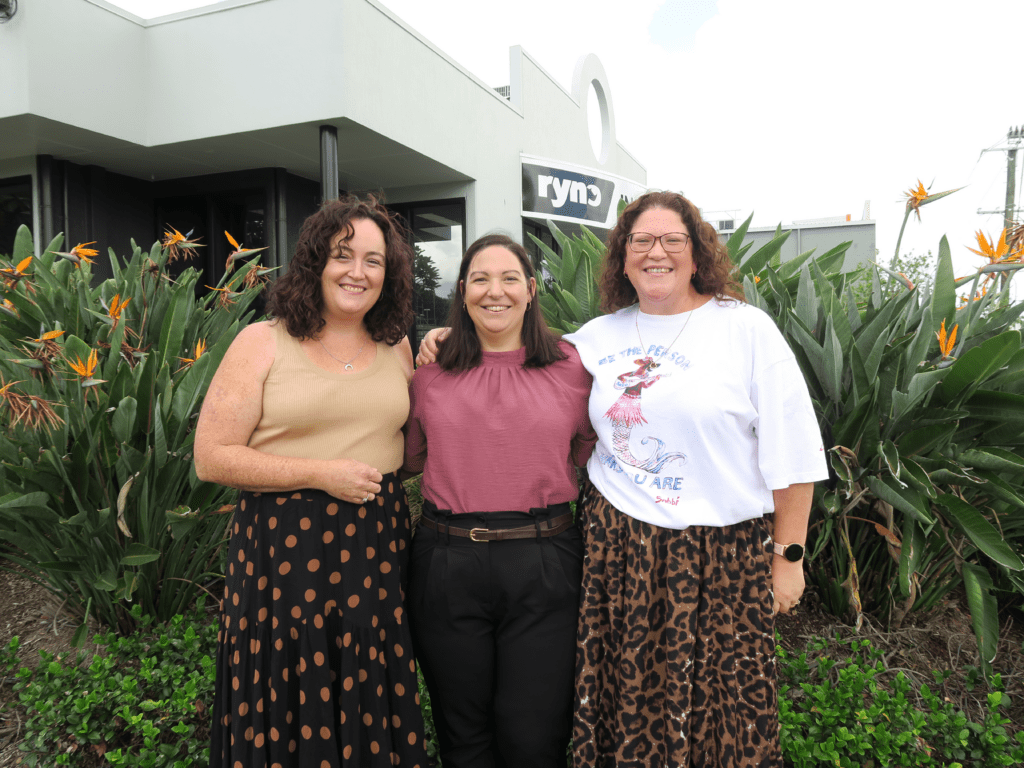
We are incredibly proud to share that two of our senior leaders have been recognised in the Insurance Business Asia-Pacific Elite Women 2026 list, one of the most prestigious acknowledgements of female leadership in the insurance industry across the region.
This year, 70 women across Asia, Australia and New Zealand were named from a field of nominees assessed on leadership impact, influence, innovation and commitment to progress. To have two leaders recognised from our organisation is something we don’t take lightly.
A Big Moment for a Small but Mighty Team
We are a collection of businesses spanning insurance, underwriting, SaaS and premium funding and we turned 40 last year. For a team of just over 40 people, having two leaders named on a list of this calibre is, frankly, a big deal. And we’re going to own that.
Rebecca: Driving Strategy and Technical Excellence
Rebecca, our Chief Insurance Officer, has been instrumental in shaping the technical and strategic heart of our business. She brings deep insurance expertise and a forward-thinking approach to everything she touches and her seat on the Women in Insurance board reflects a commitment to the industry that extends well beyond our four walls.
Kate: Building a Culture Designed to Thrive
Kate, our Chief People Officer, joined with a rich background in diversity, equity and inclusion and has been a driving force behind building a workforce that is genuinely designed to thrive. Not by accident but by design.
Transforming the Business from the Inside Out
What makes this recognition particularly meaningful is what it represents about the way these two leaders have worked together. Over the past year, Rebecca and Kate have collaborated to reshape how our organisation operates from the inside out by building the team by design and redesigning team structures, shifting the focus from presence to output, embedding a values-driven culture, and overhauling the systems our people use every day.
The Results Speak for Themselves
The results speak for themselves: employee turnover reduced by 80%.
Read that again. Eighty percent.
In an era where talent retention is one of the greatest challenges facing businesses of every size, that number is extraordinary and it didn’t happen by chance. It happened because two leaders decided that engagement, culture and people-first thinking weren’t soft initiatives. They were a business strategy.
Building the Future of Work
As we look ahead, our focus continues to evolve. We are actively exploring how AI and emerging technologies can be integrated into our workforce ecosystem in ways that support our people to stay engaged, energised and not overwhelmed. The future of work is something we’re building intentionally, not reacting to.
Looking Ahead with Pride
We are proud of Rebecca and Kate. We are proud of the team that surrounds them. And we are proud to be the kind of organisation, at 40 years young, that still has the appetite to do things differently.
Congratulations to all 70 Elite Women recognised across Asia-Pacific this year. You can read the full report via Insurance Business Asia-Pacific.
As a valued client of East West Insurance Brokers, you’re supported by a team of experts who bring more than just insurance knowledge to the table; they also have passions, hobbies, and aspirations that make them who they are. Get to know the people dedicated to looking after you and your business.
Rawinia Lim Head of Claims
Rawinia manages complex claims, ensures smooth coordination with insurers, and handle escalations when needed.
Rawinia enjoys walking her dog and unwinding at home. She’s keen to explore pottery as a new hobby, and her travel wish list includes Greece, Thailand, and a return trip to Ireland.
Alicia Newell Executive Assistant
Alicia manages staff policies and supports Insurance Advisors to deliver exceptional services to our clients.
When not at work, you’ll find her at the gym or out enjoying meals, gardening, or taking her kelpie on adventures. She hopes to explore pottery and has Canada at the top of her travel list to see her favourite comedian and experience the wilderness
Shreya Sharma Marketing Manager
Shreya oversees the marketing team and leads all aspects of marketing for the business.
Outside of work, you’ll find her gardening, hiking, or experimenting with new recipes. She’s keen to explore creative pursuits like pottery or textured canvas art, with South Africa currently at the top of her travel wish list.
See what our team are loving this quarter
Jamie Olivers Gnarly Madras Lamb Traybake
Ingredients
2kg Lamb Shoulder (Bone In)
180g Madras Curry Paste
250g Yellow Split Peas
3 Red Onions
4 Tomatoes
1 Potato
6cm Ginger
1 bulb of Garlic
15g Coriander
12 Cloves
Method
1. Score the lamb and season with salt and pepper. 2. Rub with half the curry paste. 3. Place yellow split peas in a deep roasting tray with all the other ingredients along with the remaining curry paste. 4. Stir in 1.2L of boiling water and sit the lamb on top. 5. Tightly cover with tin foil and roast at 170 degrees for 4.5 hours. 6. Remove foil, baste with the tray juices.
Cyber risk is one of the most common threats for Australian businesses. It can disrupt operations and cause serious losses.
To help businesses, the Australian Government released the Essential Eight. This is a set of eight practical cybersecurity strategies. They are designed to help businesses get back to trading quickly after a cyber incident.
Essential Eight Cybersecurity Strategies
The Essential Eight encourages businesses to:
1.Keep software up to date: Regularly update your operating systems and applications to close security gaps.
2. Control access: Only allow authorised staff to make important system changes. Remove access when staff leave.
3. Use strong passwords and MFA: Strong passwords plus multi-factor authentication (MFA) add an extra layer of protection.
4. Limit risky programs: Block or restrict applications and macros that are commonly used to spread malware.
5. Back up data often: Make frequent, secure backups. Test them to make sure you can restore data quickly.
6.Protect against phishing and unsafe sites: Reduce risk from malicious emails and dangerous websites.
7.Have a simple response plan: Know what steps to take and who to contact if something goes wrong.
8. Educate your staff: .Use monthly updates from the Essential Eight team to keep staff aware of the latest cyber threats.
Why Cyber Risk Management Matters
Insurers now look closely at cyber risk management when deciding coverage, premiums, and claims for Australian businesses. Businesses that follow frameworks like the Essential Eight are better prepared if a claim occurs.
Demonstrating these controls can also help negotiate stronger coverage or lower premiums.
What You Should Do?
If you’re reviewing your insurance or risk management, now is a good time to consider how the Essential Eight cybersecurity strategies could be implemented in your business. Contact your broker to discuss these controls in detail.
Mary-Anne has been a client of East West Insurance Brokers for 20 years and we have had the privilege to watch her business evolve from when she owned childcare centres and after-school care facilities to her present business, EPEC Education.
Tell us more about your business.
EPEC Education is a Registered Training Organisation that provides accredited training and professional development to those interested in contributing to the Early Childhood Education community.
EPEC’s training covers all aspects of the care of children with special focus on identifying and preventing child abuse.
What inspired you to start your business?
As a former Approved Provider of a range of early childhood services, I was hoping I could make a positive contribution in this space.
As a former University teacher, I believed the combination of both my theoretical and hands-on industry knowledge would make a positive contribution to the industry.
What’s the most rewarding part of running your business?
Supporting educators and other personnel to be more caring and compassionate in their interactions with the children in their care.
What do you wish you knew starting out?
That it takes a long time to develop the fundamentals of a business, and that there is always a solution to 99% of business problems.
What was your biggest challenge, and your solution?
Coming to terms with all the changing technologies. The best way to overcome these challenges is to stay acutely on top of new technologies and all the details of changing legislation.
What’s your favourite success story?
One of my proudest moments from my business journey is staying true to my belief in the importance of inclusive and compassionate care of all children.
What’s your one big goal for your business in the next year?
In accordance with EPEC’s commitment to the early childhood sector, it is starting to make moves into the recruitment sector and aims to develop this as another department of its business in 2026.
Outside of work, what do you enjoy doing?
Exercising on the beach, connecting with nature and recovering from the challenges of the previous week.
What advice would you give to other business owners?
To be successful in business you need to have plenty of strength and courage. Staying the course is about mental toughness and resilience above all else.
Where can people find you to connect or support your business?
For small business owners, work is more than just work. It is your livelihood. So when something unexpected stops you from working, the stress can be huge. This is where strong insurance claims support makes a real difference.
One of our clients in the commercial cleaning industry experienced this when their work vehicle was damaged in an accident. With jobs booked and bills to pay, being off the road was not just inconvenient. It caused real financial pressure.
The client had a Downtime benefit in their insurance policy, also known as business downtime insurance. This benefit is designed to provide income support while a vehicle is being repaired. After the breakdown, the client lodged a claim and received a repair quote that was below their insurance excess. They decided to pay for the repair privately to avoid the excess.
Partway through the repair, the mechanic found more damage. The new quote was now higher than the insurance excess. Because of this, the client chose to have the repair covered by insurance instead.
The insurer approved the repair costs. However, they declined the Downtime benefit. They relied on a policy exclusion because the first repairs had been done privately.
Our role
Our claims team stepped in to provide dedicated insurance claims support during this stressful time. We reviewed the situation and challenged the insurer’s decision. We explained that:
Any reasonable person would have made the same choice
The client acted in good faith and did not try to mislead
The insurer suffered no additional financial loss from the client going ahead with repairs
We kept the client informed at every step. We reassured them and handled the discussions with the insurer so they could focus on running their business. This is an example of strong insurance broker claims advocacy in action.
The outcome
Because of our team’s experience and persistence, the insurer agreed to pay the maximum Downtime benefit under the client’s business downtimeinsurance. The client received the income support they needed during a difficult period. This reduced financial pressure and helped them return to work with confidence.
Key takeaways:
This claim shows why working with an insurance broker matters:
Policy wording is not always final, and insurers must follow a fair claims process
Experienced claims support can challenge insurer decisions
Brokers provide insurance broker claims advocacy in complex situations
You don’t have to navigate claims alone
Insurance is about being there when it counts and we’re proud to stand beside our clients when they need it most.
Artificial Intelligence in business is now part of everyday operations. It helps with admin tasks, data analysis, and customer service. It can also help write messages and emails. AI is a useful tool for saving time and improving efficiency.
For many businesses, using AI is no longer a choice. It is becoming necessary to stay competitive. But every new tool brings new risks, therefore, it is important to understand these risks before relying on AI.
Understanding AI
A simple way to think about AI is to compare it to your home. A robot vacuum or dishwasher can save you time. But they only work well if the space is set up properly. If there are items on the floor, blocked pipes, or the machine is too full, problems can happen.
AI works in the same way.
The more AI is used in your business, the more important it is to control how it is used. You will need to manage what it can access and who is responsible for it.
Without clear rules and controls, businesses may face challenges. Effective AI risk management can help reduce:
Data privacy and confidentiality breaches
Cyber attacks or system failures
Incorrect results or false information
Intellectual property or copyright problems
Legal or regulatory issues
The Role of Business Insurance for AI
From an insurance point of view, protection must keep up with new technology.
Many insurance policies do not clearly cover AI-related problems. This is common when data, cyber risk, or professional advice is involved. Just as you protect your home and contents, you should also protect your business. This means checking your insurance regularly and making sure your coverage matches how your business uses technology, including AI.
Keeping Business Efficient and Protected
AI can make running your business easier and faster. The key is to set it up properly and ensure you have the right protection in place.
If your business is starting to use new technology or is expanding its use of AI, now is the time to talk to your broker. A review of your risk management and insurance cover, including AI risk management strategies will help make sure your protection grows with your business.
When arranging insurance for a commercial property, many owners make a common mistake: using the purchase price as the sum insured.
On the surface, it feels logical. If that’s what you paid for the property, surely that’s what it’s worth? However, the purchase price doesn’t always reflect the actual cost of rebuilding.
Purchase Price vs. Rebuild Value
It’s important to understand the difference between the purchase price and rebuild value when it comes time to insuring your property. Yes, both relate to what your property is worth, but they represent and serve very different things.
Purchase Price
The purchase price of a property represents the total amount paid to acquire it on the market. It’s affected by several factors, which include:
The value of the land.
The property’s location and market demand.
Broader economic conditions at the time of purchase.
None of these is relevant to an insurer if your building is damaged or destroyed. Insurance is about replacing the structure itself, not the land it sits on.
Rebuild Value
The sum insured is generally expected to reflect the full replacement value of the building, which includes:
Demolition and debris removal.
Professional fees (engineers, architects, surveyors).
Current labour and material costs.
Compliance upgrades (to meet today’s building codes).
What’s the difference?
The key difference between purchase price and rebuild value lies in what each represents. The purchase price reflects the property’s market value, including the land, location, and broader economic factors, while the rebuild value focuses solely on the cost to reconstruct the building if it were damaged or destroyed. This includes demolition, debris removal, professional fees, materials, labour, and any upgrades needed to meet current building codes. In short, insurance covers the cost to rebuild, not the market price you paid.
The cost of getting it wrong
If your sum insured is based on the purchase price rather than a professional valuation, you risk being underinsured. And underinsurance doesn’t just affect you in the event of a total loss. It can also reduce your payout even in the case of a partial claim. For example:
A property was purchased for $2 million, but the actual rebuild cost is $3 million
The sum insured is set at $2 million (instead of $3 million).
A fire causes $600,000 worth of damage
Because the building was underinsured by one-third, the insurer may pay only two-thirds of the claim (about $400,000)
This could leave you, the owner, with $200,000 out of pocket expenses even though the damage wasn’t a total loss.
Why professional property valuations matter
Construction costs in Australia have surged in recent years, driven by shortages of materials and skilled labour. Without a proper valuation, it’s easy to underestimate the cost of rebuilding today compared to when you purchased the property. A professional building valuation gives you:
Confidence that your sums insured are accurate
Protection from co-insurance penalties
Peace of mind that your biggest asset is covered correctly
It’s best to arrange a professional building valuation every few years and review your insurance sums annually. That way, your cover keeps pace with any changes to your property, as well as rising rebuild costs and inflation.
Avoid underinsurance with proper valuation
The purchase price reflects market conditions, not rebuilding costs. Having a commercial property is already a significant investment, and underinsurance can create unexpected financial strain during claims. To safeguard your investment, arrange a professional building valuation and review it regularly. That way, your insurance truly reflects today’s replacement costs, not yesterday’s market value.
When it comes to protecting your assets and ensuring the sums are properly accounted for, a Broker would be a huge help. If you want advice or are interested in learning about available options for commercial property coverage, reach out to East West Insurance Brokers today.
When you think of business insurance, you probably imagine it kicking in after a total disaster, like a fire that levels your building or a car that’s completely written off. But what many business and property owners don’t realise is that even if your loss is only partial, being underinsured can leave you with serious financial strain. Shortfalls in coverage can hurt so you need to be prepared before it’s too late.
What Is Underinsurance?
Underinsurance happens when the sum insured on your policy is less than the true replacement or repair cost of your asset. In other words, you’re insured for less than what it would actually cost to rebuild, repair, or replace. It’s surprisingly common especially with the rising construction costs and inflation. So, if you’re not regularly reviewing your cover, this can also leave you underinsured and underprepared.
The 80% Co-Insurance Rule in Australia
In Australia, most commercial property and business insurance policies include a co-insurance (or average) clause set at 80% of the asset’s replacement value.
What this means:
If you insure your asset for at least 80% of its true value, the insurer will generally pay the full amount of any loss (up to the sum insured).
If you insure for less than 80%, the insurer can reduce the claim proportionally even if the loss is only partial.
Example:
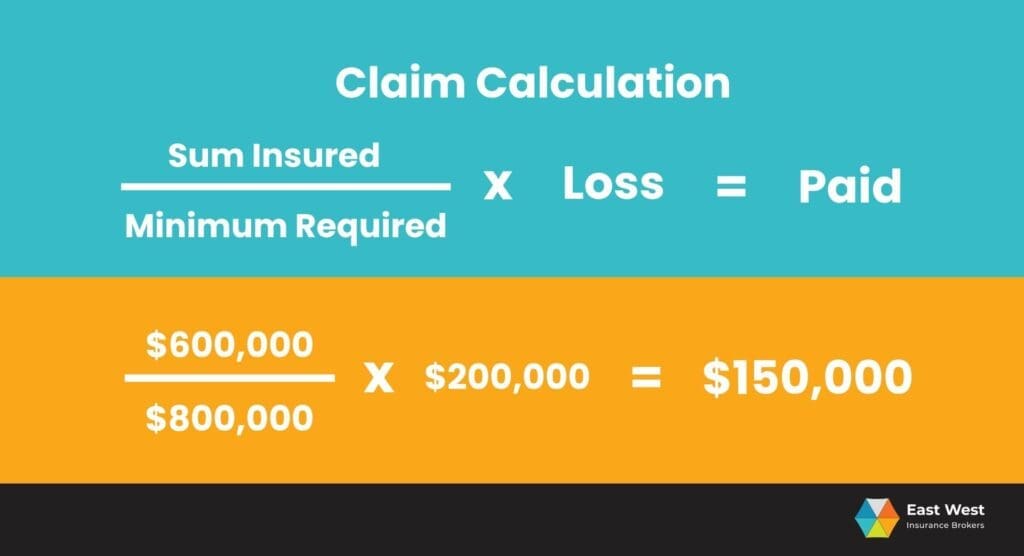
True Building Value: $1,000,000
Minimum Cover Required (80%): $800,000
Insurance Purchased: $600,000 (60% of true value)
Loss: $200,000
Claim Calculation: (Sum Insured / Minimum Required) X Loss
Example of a claim calculation.
That would be [($600,000 / $800,000) X $200,000] $150,000 paid. Even though the damage was only partial, you’d be $50,000 out of pocket because of underinsurance.
The real-world Impact of underinsurance
Unexpected repair bills – You may have to fund a large portion of repairs yourself.
Cash flow pressure – Reduced payouts can strain your business finances.
Delayed recovery – With less money to repair or replace assets, recovery takes longer.
Business risk – In some cases, underinsurance can threaten not just your return to business, but also your overall ability to keep operating.
How to avoid underinsurance
Get regular valuations – Ensure your building, plant, and equipment values reflect today’s replacement costs.
Factor in inflation – Materials and labour costs rise quickly; your insurance should keep pace.
Review sums insured annually – Don’t just renew “as is” each year.
Work with an Insurance Broker – They understand co-insurance clauses and can explain how it will affect you.
Insurance should offer peace of mind, not unpleasant surprises
You take out insurance for security, not for shock and disappointment. But if your cover is less than 80% of the true replacement value, even a partial loss can leave you with a reduced payout.
So, don’t take the risk. Review your business insurance cover with a Broker. They can even recommend professional valuers to ensure your sums insured are accurate to help you avoid the risk of underinsurance.
If you’d like the support, the team at East West Insurance Brokers is ready to help you perform a review and make sure you’re properly protected.
As Australia moves toward a greener future, the plumbing industry sees a quiet revolution. Environmental regulations are tightening, and more homeowners and businesses are actively seeking sustainable options. For plumbers, this shift presents a golden opportunity that can help them stand out in a competitive market and command premium rates —specialisation in eco-friendly plumbing services
Why Go Green?
Sustainability isn’t just a trend. It’s becoming the new standard as more people turn to greener alternatives. From reducing water waste to lowering energy bills, eco-conscious clients prioritise long-term savings and environmental impact. By positioning yourself as a specialist, you can build trust and long-term relationships with these value-driven customers and get ahead of the game.
Niche areas you can explore
While general plumbing services will always be in demand, specialising can open doors to higher-paying jobs and less competition. Consider niche areas to improve your competitive advantage:
Rainwater tank installations
Given Australia’s variable climate and increasing water restrictions, rainwater harvesting has become more valuable than ever. Installing rainwater tanks for purposes such as garden irrigation, toilet flushing, or laundry usage helps clients reduce their reliance on mains water and lower their water bills.
Greywater systems
Homeowners increasingly seek innovative ways to reuse water from showers, sinks, and laundry. As water conservation becomes more important, there is a growing demand for plumbers who can integrate greywater systems and water-efficient fixtures into homes and businesses. Greywater systems provide an eco-friendly solution that helps households reduce their water usage. By specialising in installing and maintaining these systems, you position yourself as a forward-thinking plumber who can offer both environmental and economic benefits while ensuring compliance with local council regulations.
Energy-efficient systems
With rising energy costs and sustainability at the forefront of Australians’ minds, more Australians are investing in energy-efficient hot water systems. Solar hot water, heat pump systems, and instantaneous gas units are all in high demand. By becoming an expert in these technologies, you can offer high-value services backed by federal and state incentives, making your offerings more attractive and financially accessible to clients.
Backflow prevention testing
To protect drinking water supplies, backflow prevention devices are legally required in many commercial and industrial settings. Certified plumbers who offer testing, maintenance, and compliance reporting can secure ongoing contracts with commercial clients. This niche provides a reliable, repeat-business stream and sets you apart as a compliance-focused professional.
Thermostatic Mixing Valve (TMV) Servicing
TMVs are critical in healthcare and hospitality settings to ensure safe water temperatures. Regular inspection and maintenance are required to meet safety standards. Specialising in TMV servicing provides access to a regulated market with potential for more repeat business.
Drainage & pipe relining
Compared to traditional pipe replacement, pipe relining offers a cost-effective, no-dig solution. Investing in modern equipment and training allows you to provide efficient solutions for blocked or damaged drains, appealing to homeowners and businesses.
Gas fitting services
Gas fitting is a consistently in-demand service in Australia and with proper licensing, you can handle various jobs from appliance installations to leak detection. Expanding into gas work can massively increase your earnings and service offerings.
The business advantage for sole traders
Specialisation means more than just offering a service—it’s about becoming known for it. When you focus on one or two key areas, marketing becomes easier, and referrals come faster. Plus, clients are often willing to pay more for someone with proven expertise in the solution they need You also reduce price-based competition, improve efficiency through repeated processes, and gain more profound knowledge in your chosen field—all of which help your bottom line.
Ready to Make the Shift?
If you’re thinking about expanding your plumbing business, consider how you can incorporate eco-friendly plumbing solutions into your service offering. Start with the systems you’re already familiar with, then upskill and work to get certifications to build credibility. As demand grows and sustainability becomes the norm, those who specialise early will be in a prime position to grow their business and make a lasting impact. Being an Australian sole trader plumber can be challenging at times, but it also offers incredible freedom and direct rewards. As your own boss, you have the flexibility to set your own hours, within certain limits. However, this also means that the success of your business is closely linked to your hard work and skills. To continue thriving in the plumbing industry, it’s important to embrace opportunities and invest in yourself.
As we celebrate International Women’s Day for 2025, the theme Accelerate Action encourages us to move beyond conversation and drive real, tangible change. With women’s rights and contributions in the spotlight, now is the time to refocus on achieving true workplace equity. Women bring immense talent, capability, and innovation to the workforce.
At East West Group, we believe in recognising capability, talent, and contributions— shaping our work environment and manoeuvring our work practices to provide the necessary support for these talents to thrive. “Where I was previously struggling to hit monthly targets due to a different culture, I am now exceeding them and the only real (and this is a large factor) change is the environment.,” says Sam, Insurance Advisor.
Today, we highlight three incredible women—Amanda, Erin, and Sam—who have not only carved successful careers at East West Group but have also been supported in ways that enabled them to flourish. Their stories reflect the impact of inclusive policies, leadership support, and a commitment to equity in action.
Personal Stories & Growth
Amanda: Embracing Every Opportunity
Amanda’s journey at East West Group began as a receptionist with no prior experience in insurance. Through a willingness to take on challenges and an environment that encouraged learning, she progressed through various roles before finding her place in underwriting. “My journey started a long way from where I am now! I came to the East West Group as a receptionist with no experience in the insurance industry,” Amanda recalls. “Every step of the way, the staff and management have been incredibly supportive, with no question too silly (and there were a lot of questions!).”
Amanda found that the support she received helped her navigate challenges and overcome self-doubt. “I have always had a little imposter syndrome not coming from an insurance background,” she shares. “One particular instance that recently impacted me was in a meeting discussing one of our products. I mentioned a particular trend I had been seeing, and the immediate flow-on from that saw the creation of a new product. It was a great feeling being part of something from the ground up!”
She also values the organisation’s flexibility, which has allowed her to balance her career and personal responsibilities. “I have recently moved to a compacted working week, which has been very impactful in creating a balance in working and personal responsibilities. There was open discussion in relation to how this would work, and the move to this model was seamless.”
Amanda believes that the inclusive nature of East West Group has made all the difference. “Gender has not been a barrier within EWG, with the same opportunities being afforded to both male and female staff, and in fact, the majority of the senior roles are held by women,” she says proudly.
Erin: From Support to Leadership
Erin’s career began as a part-time Broker Assistant while managing the responsibilities of being a mother to two young children. “I came to EWG almost eight years ago as a new mum of two, looking for a job with the least responsibility possible,” Erin explains. “I settled in nicely three days a week as a Broker Assistant to one senior broker. This quickly expanded to looking after a number of brokers and taking on various tasks, including training and compliance.”
She recalls how she initially struggled with self-confidence as she transitioned into leadership roles. “Moving from support into operations—I was not confident at all!” Erin admits. “I’ve always felt that I’ve flourished in the background and was generally happy to stay behind the scenes. But now, I impact more than one part of our business operations, and I wouldn’t have it any other way.”
Her leadership journey was further accelerated by her participation in the Aspire Women Leaders Program, fully funded and supported by East West Group. “I almost didn’t apply for the Aspire program, but my manager at the time encouraged me to give it a crack—what’s the worst that could happen?” she recalls. “I was stunned when I was selected, and that pesky imposter voice started nattering in my mind.”
The program provided Erin with invaluable insights into leadership. “The program was educational and at times confronting—pushing us outside our comfort zones so we could develop our leadership skills and be the best version of ourselves. The best part? Knowing that my participation was seen as a company investment, not an inconvenience.”
East West Group’s support made all the difference. “The most meaningful support was knowing that my team would cover my duties while I was away—I didn’t need to log on after hours to catch up on the tasks I missed whilst in the program. Meetings were moved, deadlines adjusted, and my involvement was only ever treated as an opportunity, not an inconvenience.”
Sam: The Power of an Inclusive Environment
Sam joined East West Group after feeling stalled in her career elsewhere. “After reaching seven years within insurance, I personally felt stalled and was looking for a role where I could push myself out of my comfort zone and continue to learn along the way,” she says. “That was definitely East West!”
She immediately noticed the team’s support. “There is never a moment where you feel like an island,” she says. “From daily casual chats with the COO about how we’re tracking to conversations with Greg about monthly results and issues we’re facing—everyone cheers each other on.”
Sam also benefited from flexibility when her partner was made redundant, allowing her to balance work and personal responsibilities seamlessly. “What was a period of transition for our family as he reskilled into his new role meant that I needed to take time away to do the school runs and work from home more than normal,” she shares. “The leadership team and the broking team I sit within were very supportive during this time.”
Sam also has two daughters who she hopes ‘find their East West in whichever industry they work within’, highlighting the importance or working to support, not only current generations of women in the workforce, but also working to support future generations.
She also emphasises the importance of representation in leadership. “Being able to look up to the next rung or even sideways and see so many people similar to myself—a working parent with commitments to family, friends, etc.—achieving targets in an open way, is inspiring. It reassures me that the next step isn’t unattainable.”
Support and Policies at East West Group
At East West Group, we believe that equity is not just about policies—it’s about how those policies translate into real experiences for employees such as Amanda, Erin and Sam. The most impactful frameworks include:
Being open to flexible work arrangements: Whether it’s compacted workweeks, adjusted schedules for school drop-offs, or remote work opportunities, flexibility is a consideration to ensure we are giving our best to our team so they can be their best.
Outcome-Based Performance: We focus on results, so a trust-based model allows employees—especially working parents—to excel professionally while managing personal responsibilities.
Fair & Equitable Pay Structures: Regular benchmarking and position reviews ensure transparency and fairness, addressing gender pay gaps and promoting equity.
Overcoming Challenges & Accelerating Action at East West Group
While progress has been made, challenges remain within our industry.
Breaking Gender Bias: Historically, insurance has been a male-dominated industry, with brokers being men and support staff primarily women. Erin recalls sitting in a licensing exam where she was one of only three women in a room of 25. “Clients have sometimes preferred dealing with male brokers,” she notes. “But at East West Group, I’ve always felt that being a woman is an advantage.
Building an Accessible Workforce: The key to breaking systemic barriers is shifting perspective. Organisations must ask themselves: Is our workforce truly accessible? Or are we prioritising traditional practices over attracting and retaining top talent? At East West Group, we constantly challenge outdated thinking, ensuring our frameworks evolve to create opportunities for all.
The Role of Self-Awareness and Transparency: Transparency, feedback, and openness to new ways of working are essential in driving continued progress. Businesses must actively listen, assess, and refine their structures to foster long-term equity.
Looking Forward: A Call to Action
International Women’s Day is more than a celebration—it’s a call to push boundaries and drive change. At East West Group, we are committed to continuous improvement, not just in policies but in actions that make a difference for our teams and for our clients.
The experiences of Amanda, Erin, and Sam are proof that when organisations are open to flexibility, mentorship, and genuine inclusivity, not only women thrive- it’s a benefit for all.
As workplaces, we must remain adaptable, and proactive in accelerating action toward gender equality.
As Erin wisely states “people flourish where they feel safe to do so. Do what you say you are going to do. Communicate if you can’t.”
This International Women’s Day let’s not just talk about change—let’s accelerate it.
Protect your business with tailored commercial property insurance from our Australian experts. Over 40 years of experience. Get your free quote today!
What do a cozy cafe, a small retail shop, and a towering office building have in common? They all face similar risks when it comes to protecting their property. From fires and floods to theft and vandalism, these unexpected events can disrupt operations—or even force a business to shut down entirely.
That’s why having appropriate commercial property insurance is important. Whether you own or lease your space, your insurance can be the lifeline safeguarding your business from financial fallout.
But before you start insurance shopping, you should first get your commercial property professionally valued.
What is a property valuation?
The estimated market value of a property, which a qualified professional appraiser usually performs. This assessment is based on various factors, which include:
Condition of the property
Existing structures
Location and proximity to other facilities
Market trends
Renovations and upgrades
Size and layout
Valuation of similar properties within the area
There are two main types of property valuations, each serving different purposes. Understanding the distinction between them is crucial to avoid costly mistakes.
Real estate valuation – Used for buying, selling, or securing a mortgage. This type of valuation assesses a property’s sale value, which is influenced by current market trends.
Insurance valuation – Used in insurance applications. It focuses on the cost of rebuilding or repairing a property based on current construction costs.
Insurance valuations are sometimes calculated using a $ per square metre estimate. However, general property valuers may not be qualified to quote rebuild costs. To ensure you’re not underinsured, it’s recommended to consult a surveyor for a more accurate figure.
It’s also important to remember that real estate and insurance valuations can differ significantly, sometimes in millions, and should not be used interchangeably.
How can property valuation impact insurance?
Insurers may use the property valuation report to determine what coverage is necessary and calculate the total cost of the premiums they’ll offer. A higher property value can mean more payouts are required in the event of a repair or replacement claim, leading to higher premiums. On the other hand, they may offer lower premiums to properties with lower value. The catch is this may mean less coverage and more out-of-pocket costs in case of a claim.
You need an accurate property valuation to balance adequate coverage and manageable premiums. This would help you avoid the following:
Over-insuring
Securing as much coverage as possible may sound like the safer option. However, insurers typically don’t pay more than the actual repair cost or the property’s market value. If your property is overvalued, this might lead to over-insuring and paying higher premiums for coverage you may not even need.
Underinsuring
Undervaluing your commercial property to pay lower premiums may sound like an easy way to save money, but it won’t help your business long-term. You may end up exposed to the risk of being underinsured in the event of a claim. Payouts from insurers may not cover enough repair or replacement costs, leading to additional financial strain.
Penalty fees
Policies may include a ‘co-insurance’ clause, which requires the property to be insured to a certain percentage of its value. If your property is found to have been undervalued, your insurance company may penalise you with a penalty fee or reduce the payout in the event of a claim.
Legal issues
An inaccurate commercial property valuation may also violate contractual agreements for leasing and mortgage.
It’s advisable to have your property professionally revalued every few years or whenever significant changes occur, such as renovations, expansions, or shifts in the local market. This helps you and your insurance provider update your coverage to match your business needs.
Having accurate and up-to-date valuation also minimises disputes during claims because insurers are better equipped to assess losses accurately, ensuring a smoother claims process.
Secure your commercial property
Having an accurate and up-to-date property valuation empowers you to make smart financial decisions while ensuring you have adequate insurance coverage to protect your investment. In business, preparation is everything—and staying ahead begins with understanding the true value of what you own.
Want to learn more about commercial property insurance? Connect with East West Insurance Brokers! Our team of expert insurance brokers can provide valuable insights into commercial property coverage for you and your business. Contact us today to get started!
The future of the global welding industry looks bright. As demand from sectors like automotive, construction, and heavy engineering continues to rise, the industry’s value is projected to grow from USD 24.73 billion in 2023 to USD 34.18 billion by 2030. Australia is poised to be a key player in this exciting transformation. But what developments are in store for the welding industry?
Increasing Demand for Skilled Welders
“By 2030, we will be 70,000 welders short“, according to Geoff Crittenden, chief executive of Weld Australia. It’s an issue faced by other countries, such as the United States and Japan.
While the worker shortage can mean more employment opportunities for aspiring welders, given the numerous ongoing infrastructure and expansion projects, there is a pressing need to address it now. As a result, the Australian government is encouraging more investment in the welding industry by funding businesses and nurturing the talent pool through various programs.
Promoting Diversity in Trades
Women make up 48% of the country’s workforce. However, less than 1% in the welding and fabrication sector are women. Part of addressing the worker shortage is taking a proactive approach to promoting opportunities for women. In 2022, the Victoria government launched the Building Equality Policy to support women in getting into male-dominated industries. More projects are also being funded to encourage other underrepresented groups to enter trades and STEM training.
Skilled Migration Program
Australia is also looking to address the labour shortage with the Skilled Migration Program, which reopened in October 2023 with new criteria. The government has streamlined the visa process to help experienced and skilled tradespeople from overseas apply for jobs in Australia. This helps fill vacant positions and fosters regional development by introducing global talents.
Innovation Through Technological Advancements
As demand grows, technology advances to cope, and the welding industry is no exception. The launch of Industry 4.0 last year has given a boost by pushing for the integration of digital technologies like AI, Internet of Things (IoT), and robotics. These have dramatically enhanced productivity while supporting Australia’s sustainability efforts by promoting energy-efficient practices. Here are just some examples:
3D printing – Allows for the rapid creation of prototypes and complex components, unlocking new design possibilities while minimising waste during the design phase.
Internet of Things (IoT) – Utilises real-time data reporting to enable predictive maintenance, helping reduce downtime and enhancing operational efficiency during critical issues.
Robotic and laser welding – Transforms traditional welding practices by enhancing precision and quality, creating new opportunities for businesses to optimise and deliver superior results.
Switching to Renewable Energy
35% of the total electricity generated in Australia last year was from renewable energy sources. It’s only expected to rise in the following years as the country ramps up efforts to transition to greener energy sources as part of the nationwide goal of reaching net-zero carbon emissions by 2050. Multiple legislation and projects have been introduced to boost support.
Capacity Investment Scheme
First introduced in December 2022 and then expanded in November 2023, the Capacity Investment Scheme aims to unlock $40 billion in private investment into the local manufacturing industry to create more jobs and improve local economic participation in the renewable energy transition.
Future Made in Australia Act
One such effort is the Future Made in Australia Act, a major piece of legislation passed in 2021. Under this, the Australian government commits to providing funding and incentives for businesses to invest in manufacturing capabilities and to adopt cleaner technologies. It aims to make the country’s economy more sustainable, increasing the resilience of supply chains and boosting the manufacturing industry’s ability to compete globally.
State Prosperity Project
The South Australian Government also launched the State Prosperity Project early this year to reindustrialise the Upper Spencer Gulf by harnessing its mineral resources, renewable energy, and green manufacturing potential. The project is in partnership with education and training providers like the Technical College in Port Augusta, opening in 2025. This college will adopt a part-time operation model, offering industry training and work opportunities across the region.
Evolve with the Welding Industry
As the welding market evolves and unveils new opportunities for innovation, you need to continue learning and enhancing your skill set. Stay alert to new trends so you can embrace them and secure a stronger competitive edge. You also need to be aware of any potential risks you’ll face in the industry.
Safeguard your journey with East West Insurance Brokers. Our team of insurance experts will guide you through your insurance options, empowering you to make informed decisions to protect your business.
Visit our website today to request a quote so you can confidently forge ahead!
Retail businesses face more unique challenges today when it comes to security. Threats are not only limited to physical damages and losses. With more people relying on digital transactions, online threats are ever-changing and can even be more damaging.
In this blog, we’ll discuss security strategies you can implement to safeguard your retail business. From offline to online, we’ve got you covered!
A well-designed store layout can do wonders for business growth. Customer experience can be improved by making it easier to find things they might like or need. You can boost sales by highlighting marketable or high-priced items. It can also improve your store’s security by deterring theft and intruders.
A good theft prevention strategy is reducing blind spots would-be thieves could exploit. You can do this by strategically placing shelves and installing mirrors between the aisles. This makes it easier for store employees to monitor customers and send alerts in case of emergencies. It’s also recommended to place higher-priced products near where employees can keep a close watch, preferably far from any exits.
Install surveillance and alarm systems
Ensuring complete visibility within a store is hard, and employees can’t keep an eye on everything at all times, so integrate surveillance and alarm systems in your store. Install security cameras near any entrances or exits, parking areas, and cashier stations. You can prop them up so they’re more visible and act as a deterrent. However, the more visible your cameras are, the easier they can be to avoid or destroy during a break-in.
For additional security, consider installing motion detectors with lights and alert systems to scare off potential intruders. Installing glass break sensors for windows and displays is also recommended.
Control access
Limit access to areas like stockrooms, offices, and surveillance rooms. Most stores have passcodes which can be easy to set up but also be easy to bypass. To enhance your store security, consider implementing key card systems or biometric scanners with secure locks to effectively control access and ensure that only authorised personnel can enter these areas.
Cybersecurity
Protect sensitive digital information with data encryption
As a retail business, customers often share sensitive information like their names, addresses, phone numbers, and credit card details. If this information falls into the wrong hands, it could damage your business and pose a threat to your customers’ personal security. Improve your digital security by implementing end-to-end data encryption.
Provide secure payment processing
One of the most common times that’s prone to data theft is during payment processing for digital wallets and cards. Vet third-party payment vendors. Perform comprehensive research on their background and customer feedback.
Perform checks and updates regularly
Don’t be complacent after installing cybersecurity measures. Stay vigilant and frequently check every software or security system to ensure it’s always up to date. This will help you detect abnormal activities, malware, and potential security breaches.
Employee Training
Train for identifying and preventing theft
Your employees are your greatest asset and, with proper training, can be very helpful in improving store security. Encourage vigilance and regular checks. Provide training on identifying suspicious behaviour, learning theft prevention strategies, and implementing store security policies.
Cyber threats can also target your employees so it’s important to provide comprehensive training on how to handle sensitive information, including customer data and payment details.
Perform regular audits
Besides regularly performing cybersecurity checks, it’s also important to perform regular audits on your store’s physical inventory. This helps ensure accurate stock levels and identify discrepancies early. Regular inventory checks are also a good theft prevention strategy by encouraging employees to be accountable.
Insurance
General Liability Insurance
Having General Liability Insurance provides added financial security by protecting your business against claims of personal injuries, property damage, or loss within store premises. For example, if a customer is pickpocketed inside your store or injured in the parking lot and then accuses the store of negligence, General Liability Insurance may help cover repair and legal costs.
Commercial Property Insurance
Commercial Property Insurance, like General Liability, can cover repair and legal costs. The difference is that it can provide coverage for losses directly suffered by the store from incidents like property damage, inventory theft, and equipment breakdown.
There are many factors and risks that you need to consider, so it’s best to speak with an insurance broker. You can contact East West Insurance Brokers to submit an inquiry and receive more information.
Business Interruption Insurance
Unforeseen circumstances and emergencies can cause significant financial damage to retail businesses, so Business Interruption Insurance is necessary. Depending on the coverage you include, it can cover loss of income, ongoing expenses during repairs, and even temporary relocation costs.
Secure your retail business with appropriate coverage
Want to find appropriate coverage for retail business insurance but don’t know where to start? Our East West Insurance Brokers team is ready to help you explore your options to protect your business. Get in touch and secure your future with us today!
The business world can be unpredictable, and even minor events can disrupt daily operations and affect your profits. That’s why having Business Interruption Insurance is critical to a solid risk management strategy. But what is Business Interruption Insurance, and how can you ensure you have the appropriate coverage for your business’s needs?
Business Interruption Insurance covers lost business income or profits and operating expenses when the business cannot operate as usual. Incidents may include natural disasters and when a facility or equipment sustains damage. However, Business Interruption Insurance works differently from Property and Equipment Insurance. Rather than providing cover for property repair or replacement costs, business interruption aims to cover the loss of income to the business due to the damage sustained or equipment breakdown.
Examples of Benefits and Coverage
Various benefits and specialised coverage areas are needed to maintain financial stability and reduce the damage caused by disruption to business operations. Here are some common examples of the benefits and what the insurance typically covers:
Income loss (calculated based on previous financial statements)
Operating expenses (utility bills, property rent, other fixed costs)
Employee wages (may include benefits and training costs)
Tax and loan payments
Additional expenses (relocation, equipment repair or rental)
Specific exclusions and constraints can be added to the insurance policies that you must watch out for. It’s ideal to routinely review coverage details to avoid surprises when an incident occurs. You also need to check for other coverage that may be required depending on the nature of your business and service. Contact East West Insurance Brokers to explore your options and find the insurance that suits your business.
Common Mistakes and How to Avoid Them
Underestimating coverage needs and costs
A common oversight many business owners make is underestimating the full impact of operational interruptions and focusing solely on lost revenue. When evaluating Business Interruption Insurance, consider the entire spectrum of operational costs, from daily expenses, employee wages and benefits to supply-related expenditures.
Where your business is located and what type of industry you’re in plays a vital role in determining the necessary coverage and premium costs. Those operating in high-risk areas and industries require even more comprehensive coverage. Properly assessing these elements when selecting your policy helps ensure your business remains resilient despite unexpected challenges.
Failing to review and update insurance policy terms and conditions
Business Interruption Insurance policies vary regarding coverage, limits, and exclusions. Before signing the dotted line, it’s essential to review the insurance policy terms and conditions to ensure it meets your business’s specific needs. Pay close attention to factors such as the waiting period before coverage kicks in, the length of coverage, benefit period, and any limitations on coverage for specific events.
Remember to review current insurance coverage regularly after signing, too. Always take a proactive approach and stay informed about your policy details. It can help you identify any necessary updates or adjustments as your business grows and evolves.
Not considering additional or specialised coverage
Each business is unique, with specific challenges and requirements shaped by its industry, location, and operational scope. Part of a good risk management strategy should be evaluating the additional or specialised coverage and integrating custom insurance solutions. So, consider the following:
Prevention of Access (PA)
Many unforeseen events can disrupt business operations, from natural disasters to other dangerous situations. These may prevent you from operating your business and even restrict access to your premises by a legal authority ordering the evacuation of the public. This is where Prevention of Access comes in. It’s a specialised type of coverage under Business Interruption Insurance that protects against loss resulting from interruption of, or interference with, your business as a result of damage or threat of damage to property in the vicinity of the premises covered by the policy.
Suppliers and/or Customers Premises (SCP)
SCP is a specialised type of coverage that aims to protect businesses from financial losses resulting from property damage or loss at specified suppliers’ or customers’ premises. Suppose a manufacturing company faces significant delays and income loss due to a key supplier’s failure to deliver the necessary components in production following an insured event at their location, SCP can help mitigate the loss. On the other end of the supply chain, if your business relies on revenue from major customers who cannot complete their purchases due to property damage at their own premises, you can file a claim to minimise your losses.
Public Utilities Extension (PUE)
While SCP protects against issues with third-party businesses in the supply chain, PUE is related to utility providers. It mitigates financial instability when utility services fail and disrupt normal operations as a consequence of damage to any land-based property anywhere in Australia or New Zealand. This includes incidents involving any utility company producing, transmitting, supplying or delivering electricity, gas, water, sewerage or communication products or services used by the business. Companies in manufacturing, hospitality, and IT can significantly benefit from PUE.
Inaccurate or improper documentation
If you’re filing an insurance claim for loss of revenue, proper documentation is critical to ensuring that you receive the full benefits of your Business Interruption Insurance policy. Keeping detailed records of your finances and any communication with your insurance provider also reduces the likelihood of being denied.
Seek advice from a professional
Avoid making these common mistakes. Discover how to calculate your Business Interruption Insurance and get a reliable estimate. Seek advice from a professional insurance broker to ensure your business is covered as effectively as possible.
East West Insurance Brokers can assist you in evaluating your business’s requirements and comparing coverage options from multiple providers. Our team of experienced Insurance Advisors will provide valuable insight as you navigate different policies’ various terms and conditions. Get in touch with us today and get insured.
Starting a new business can be an exciting and challenging endeavor but as a new business owner in Australia, you will have many things to consider, including finding business insurance with suitable coverage. To help you on your journey, we have compiled a checklist of coverage based on your general business needs and how insurance can protect your business.
We live in a digital age with growing cyber threats. So Cyber Liability Insurance is becoming increasingly important, especially for businesses that store sensitive customer data or rely on technology and online platforms for their operations. The level of security may differ, but generally, Cyber Liability Insurance provides coverage for data breaches, cyber-attacks, and other online threats like hacking or data theft that can impact your business.
Public Liability Insurance
If your business interacts with or works with the public, one major insurance you’ll need is Public Liability Insurance. It provides coverage for claims against your business from property damage or third-party personal injury caused by your operations. This can be from activities at the workplace or at another location. Public liability insurance helps protect you from potential lawsuits.
Product Liability Insurance
Similar to Public Liability Insurance, product liability provides coverage for claims of property damage or third-party personal injury. The difference is instead of being a result of operations, product liability covers claims made against the products you sell or supply.
Professional Indemnity Insurance
When you provide services or advice to customers, Professional Indemnity Insurance protects your business from claims of negligence or errors and omissions in your services.
Insurance for Properties and Assets
Commercial Property Insurance
Whether small or big business, Commercial Property Insurance is essential regardless of your industry. It covers any properties or assets used for your business operations, including infrastructure, equipment, and inventory against damage or loss due to fire, theft, vandalism, or natural disasters.
Investing in property insurance is not just about compliance or managing risk but also about ensuring the continuity and resilience of your business. By protecting your physical assets, you can mitigate the impact of unforeseen events, keeping your operations running smoothly and speeding up recovery after adverse situations.
Equipment Breakdown Insurance
You’ll want Equipment Breakdown Insurance if your business relies on machines or technological equipment. This is not typically included in standard Commercial Property Insurance but is essential for businesses in manufacturing, technology, restaurants, and any other niche that heavily depends on functional equipment.
Equipment Breakdown Insurance can cover the repair or replacement costs of equipment that breaks down unexpectedly due to causes like motor burnout, power surges, or mechanical malfunctions. Beyond covering physical damage, it often addresses business losses incurred from equipment downtime, such as lost income and extra expenses needed to expedite repairs or procure temporary replacements.
Flood Insurance
Flood Insurance may only sometimes be included in Commercial Property Insurance. However, it is still a must-have, mainly if you operate in areas prone to flooding or work in an industry where the threat of flooding can derail business operations.
Finance Insurance
Business Interruption Insurance
When business operations are disrupted, whether by fire or weather conditions, Business Interruption Insurance can help you remain financially stable by covering the loss of income and even unforeseen expenses.
Credit Insurance
Credit Insurance is a risk management tool that helps businesses protect themselves from potential losses if their customers are unable to pay their debts. It’s particularly useful for businesses offering credit to customers, providing confidence when entering new markets or dealing with larger accounts. This insurance also helps companies manage credit risk effectively and optimize credit and collection procedures, safeguarding their financial health.
Workers’ Compensation Insurance
Workers’ Compensation Insurance is a mandatory insurance policy for businesses in Australia aimed at protecting employees if they become ill or injured due to their work. This type of insurance provides coverage for wages lost during the time off work, medical expenses, and rehabilitation costs needed to help the worker return to work.
The requirements and implementation of Workers’ Compensation Insurance can vary considerably across different states and territories in Australia. Differing regulatory bodies also manage worker’s compensation schemes. The State Insurance Regulatory Authority (SIRA) regulates those based in New South Wales, but WorkSafe Victoria manages insurance in Victoria.
So, before you work on finding business insurance for Workers’ Compensation, check your local regulatory office to ensure compliance.
Get your business insured
Finding business insurance doesn’t have to be complicated or stressful. At East West Insurance Brokers, we specialise in simplifying the process, helping you find the insurance coverage that best fits your business needs. Whether you’re just starting or looking to enhance your current policies, our team of dedicated Insurance Advisors is here to guide you every step of the way.
Don’t let uncertainties slow you or your business down. We’re here to help you secure your business’s future. Contact us today and get insured.
Getting business insurance is essential, but the first step of obtaining a business insurance quote can be very demanding. This process requires you to provide extensive information about your business, not only for assessing and understanding the potential risks your business may face but also for determining the most effective protection strategies and estimating the overall cost of business insurance. But what exactly is required to get an accurate insurance quote?
Provide detailed information about your business to make it easier to assess the level of risk associated with insuring your business and affects the total cost of business insurance. This generally includes the following:
Business Name: The legal name of your business.
Business Address: The physical location of your business.
Industry Type: The industry or sector in which your business operates.
Number of Employees: The total number of employees working for your business.
Annual Revenue: The yearly income generated by your business.
Previous Insurance Coverage: Details of your business’s previous insurance coverage (if any).
2. Assets and Inventory
Another essential piece of information you need to provide is a comprehensive list of current assets and inventory. This should include specifics about the property where your business operates, the equipment utilised in daily operations, and any other assets requiring insurance coverage. The total value of your assets is factored in the calculation of your business insurance quote and can affect what coverage is recommended which leads to the next thing that needs to be assessed.
3. Coverage Needs
Clearly outline your coverage needs when you’re looking for a business insurance quote. By understanding and clearly expressing the specific protections your business requires, you help your insurance provider create a quote that matches your business’s unique needs. This careful preparation not only leads to a more accurate assessment but also ensures that you get the best and most comprehensive coverage.
Here are some examples:
General Liability Insurance – protection against claims of bodily injury or property damage to third parties resulting from business operations.
Property Insurance – covers damage to business property and assets due to events such as fire, theft, vandalism, or natural disasters.
Cyber Liability Insurance – with the increasing threat of cyberattacks and data breaches, businesses need coverage to protect against losses due to hacking, data theft, or other cyber incidents.
Commercial Auto Insurance – if your business owns vehicles or if employees use their vehicles for work purposes, this insurance provides coverage for accidents, injuries, and property damage involving those vehicles. This can be especially useful if employees often travel for work events.
Product Liability Insurance – for businesses that manufacture or sell products, this coverage protects against claims of injury or damage caused by defects in those products.
If you need clarification on what other types of coverage your business will need, contact East West Insurance Brokers. We are here to help you assess your requirements and needs to find the best coverage plan.
4. Claims History
Be ready to provide detailed information about any past insurance claims your business has filed, including the nature of the claims and the amounts paid out. Your business’s claims history is a significant factor in determining the cost of your insurance premiums.
Insurance providers use this history to gauge the risk level of insuring your business. A track record of frequent or high-value claims might indicate higher risk, which could lead to increased premium costs. Accurate and comprehensive details about your claims history help the insurance company provide a fair assessment and pricing for your coverage.
5. Risk Assessment
Factors such as your industry, business operations, location, and safety measures are pivotal in the risk assessment process. Providing detailed and accurate information about these aspects will help ensure that your insurance quote is accurate and tailored to your needs. Many insurance providers include risk assessment services with their policies, offering a convenient option for assessing your business risks. Alternatively, hiring a specialized risk management consultant can provide a more in-depth analysis tailored to your specific industry or business niche.
Conducting your own risk assessment is another viable strategy. Start by identifying potential hazards, vulnerabilities, and threats that could impact your business operations. Also consider external factors from economic conditions, local and global politics, as well as health and environmental issues.
Staying informed through industry publications and news sources is crucial for anticipating and mitigating future risks. There are multiple online resources available to assist businesses in conducting self-assessments and pinpointing potential risks. Being proactive can empower you to better manage and analyse your business’s vulnerabilities.
Looking for a convenient way to get a business insurance quote?
Conducting your own risk assessment to get an estimate cost of business insurance can be time-consuming, particularly when your priority is managing day-to-day business operations. At East West Insurance Brokers, we understand the importance of your time and the complexities of navigating multiple insurance policies. Our team is dedicated to guiding you through the process and identifying the coverage that best suits your needs. Contact our team today to streamline your insurance process and ensure your business is protected.
Agriculture is a cornerstone of Australia’s economy and food security. The industry, however, is vulnerable to climate change, soil degradation, and water scarcity. Weather, pest outbreaks, and market fluctuations also threaten farmers’ financial security. That’s why it’s recommended that farmers get agriculture insurance for financial protection and stability amid environmental uncertainties.
Whether you’re a small-scale farmer or part of a large agricultural operation, considering agriculture insurance is a wise decision, and East West Insurance Brokers is here to help. Our team of expert Insurance Advisers can help you navigate the insurance market and shop around for a good coverage plan. Contact us today to stay protected.
Government agencies and nonprofit organisations alike have implemented initiatives to enhance agricultural productivity while preserving natural resources. Let’s explore a few of these programs and initiatives driving sustainable agriculture in Australia.
Australia’s Net Zero Plan is a bold and ambitious initiative to reduce carbon emissions by 43% by 2030 and achieve net zero emissions by 2050. The plan seeks to achieve these goals through the support of independent and nonprofit organisations, to create a more sustainable and environmentally friendly future for Australia.
But how does this affect the agricultural sector?
Well, the agriculture industry plays a significant role in greenhouse gas emissions (GHG), mainly through livestock production, fertiliser use, and land use changes. They account for 15% of the total emissions in 2019. Meeting net zero targets will require substantial changes in farming practices, potentially impacting productivity, profitability, and livelihoods. Here are the common practices that are being adopted today:
Acceleration of the transition to renewable energy
Planting cover crops to improve soil quality and prevent erosion
Improving fuel efficiency of fishing vessels
Investing in new technology to increase efficiency and reduce waste or raw material consumption
For their part, the Australian Government is developing plans to provide farmers with the necessary education and support to reduce GHG emissions.
Climate-Smart Agriculture Program
The Australian Government established the $300 million Climate-Smart Agriculture Program through the Natural Heritage Trust (NHT). Below is a sample of programs they offer grants to farmers:
Partnerships and Innovation Grants
The program offers grants ranging from $250,000 to $5,000,000 for medium to large-scale projects that promote climate-smart agriculture practices. The application for the first round began on 22 February 2024, and the second round is still being discussed.
Small Grants
Another grant is offered for projects focused on increasing on-farm productivity and sustainable agriculture for community groups. The start date for application is to be announced later this year.
Soil Capacity Building
The Australian Government has invested $21 million in a program that monitors soil quality nationwide. This program aims to gather and assess data about soil trends. Additionally, $6 million has been invested in improving the sharing and use of soil data through the Australian National Information System.
NFF 2030 Roadmap
The National Farmers’ Federation (NFF) spearheaded the development of the NFF 2030 Roadmap, which was developed through a collaborative process that involved more than 300 representatives in the agricultural sector. Created as a strategic blueprint, the 2030 Roadmap identifies key opportunities and challenges in the agricultural sector. Essentially, it’s developed as a guide for growth and sustainability.
The NFF releases annual reports to track progress, maintain accountability, and push continuous innovation for everyone involved. You can access the 2030 Roadmap and its annual reports here.
Australian Agricultural Sustainability Framework
Another initiative by the NFF, with the support of the Australian Government, is the Australian Agricultural Sustainability Framework (AASF). It aims to promote responsible environmental stewardship by upholding ethical practices in compliance with the law, reducing GHG emissions, and preserving the environment. The framework also encourages the development of communities by nurturing the well-being of people and animals.
The AASF started in 2020 and is still in ongoing development. However, you can visit their site to learn more about the initiative.
FutureFeed
Farming, particularly livestock, is a major methane emitter and GHG contributor in Australia. As a solution, the Commonwealth Scientific and Industrial Research Organisation (CSIRO) established the FutureFeed program.
It aims to reduce GHG emissions, boost animal health, and improve farm efficiency with the development of a sustainable feed supplement for livestock using Asparagopsis seaweed.
FutureFeed currently provides licenses for growers and processors rather than selling seaweed directly. If you want to buy the product for your livestock, you can buy from their licensed seaweed growers.
The Future of Sustainable Agriculture
Challenges and triumphs, emphasising innovation, adaptation, and collective action, mark Australia’s journey toward achieving net zero carbon emissions by 2030. The goal, however, extends beyond meeting the deadline. It sets the stage for a sustainable future that preserves Australia’s diverse environment while pushing for innovation and collaboration across all industries. Australia is also contributing to the global fight against climate change for a greener future by adopting transformative technologies and forming eco-partnerships.
It’s a new year and a fresh slate for everyone, and nothing beats getting started on the right foot. Business will soon start to pick up and you’ll find yourself back in the swing of things, so why not take this opportunity to comb through your business insurance to ensure that it’s still appropriate to your current business needs?
If it’s been almost 12 months since you signed up for a policy, then you will soon be receiving a renewal notice from your insurer. Unfortunately, a lot of business owners only give the renewal notice a quick glance before signing off, not taking into consideration if the cover still applies to them. By doing this, you’re putting yourself at risk of being underinsured or in a cocktail of policies that are no longer suitable for you because of the changes your business has undergone over the past year. In the current hard market situation where premiums and excesses are high and insurers are tightening their belts, it is especially important to review all your policies to prepare for when you actually need it.
We’re going to cover the steps on how to review and renew your business insurance, so that you’re properly set up for the year ahead.
Work with a qualified broker
A detailed review of your current business needs will take a considerable amount of time especially if you’ve made some changes within the last year. Your broker is not only the middle person between you and the insurer, he or she is also the key to identifying insurable risks so that you can obtain the most optimal cover for your industry at best possible premium costs.It is important that you keep in touch regularly to update them on any changes, plans, or incidents so that they can advise you on the claims process and next steps. If there are any major changes, your insurer will also need to be notified (a little something called Duty of Disclosure). If you’re already working with a broker, they will be able to communicate these changes to your insurer for you.
Get a head start
No one likes a late notice, and this goes for renewals too. If there are changes to be made, this would involve a number of documents to complete, and your broker would need some time to discuss these changes with the underwriter. Starting the review with only days to spare only allows for surface level skimming where important points are missed, and decisions are made in haste.To ensure you get the best outcome possible, you need to talk to your broker at least four to six weeks before your renewal. The more time they have, the better it will be to thoroughly review your application, submit additional information, and negotiate a better deal for you.
Document all changes to your business, big or small
To know the kinds of revisions or updates to implement in your policy, your broker will need to know how your business has changed over the past twelve months. For example, have you purchased or sold major assets or equipment? Have you moved into a new premise? Have you hired more employees? Have you implemented a hybrid working arrangement for your staff? The answers to these questions and many more serve as a good guide as to whether your cover needs updating, or if the premium is likely to increase or decrease.
Document your risk management processes
Another important step to help put you in a good light is to provide the insurers with documentation detailing how you mitigate the risks typical of your industry and your own business. Your insurance broker will be able to help you with this once every year or two. Basically, the more you can show the underwriters that you are taking careful considerations about managing your risks, the likelier you are to secure a better deal. Like we said before, the current hard insurance market makes insurers pickier about who they choose to underwrite, so the better the risk management, the less likely there will be claims.
Know your options
Your broker will come back to you with a list of insurers and policy coverage, which can vary from business to business. Your broker will only present options with good quality coverage and that are appropriate to what your business needs. There can be a fair bit to consider, especially with so many variables to compare, but your broker is there to help you make the best decision for your circumstance.If you’re not already working with a broker, then it’s time we get you connected! We can help simplify a complicated process and work closely with you to find the optimal insurance cover for your business. Get in touch with us today using the contact bar below:
At East West Insurance Brokers we have nearly four decades of experience and work with clients on all sides of the hospitality industry, all around Queensland. Our friendly and knowledgeable Insurance Advisors are here to help. Get in touch today.
The costs of construction are at an all-time high and aren’t showing any signs of settling down. These soaring construction costs from rising inflation rates, labour shortages and supply chain delays are impacting those in the property market, namely commercial property owners. A report by CoreLogic revealed that national construction costs have increased by 7.3% over 2021. This is the highest annual growth we have seen since March 2005.
While this is welcomed news for the construction industry, commercial property owners are painfully enduring the pinch. With these new challenges hanging overhead, the risk of being underinsured becomes a very real threat for many.
What’s causing the inflation of construction costs?
There are several factors responsible for the current increase in building costs, including:
1. A shortage and backlog in production of supplies due to a halt in manufacturing facilities during the lockdowns
2. Price inflation of building materials, mainly timber and steel caused by material shortages
3. Skilled labour shortage
4. Current state infrastructure projects placing a stronger demand on materials and skilled labour
5. Nationwide construction growth
6. Increase in demand for repair and maintenance works due to recent extreme weather events
7. Rise in energy rates, resulting in production costs of some materials to increase
What does this mean for your insurance?
Unfortunately, when there is a spike in building materials and construction prices, this in turn impacts property replacement value and rebuild costs. For example, if your commercial property was damaged by severe weather and you need to make a claim, the costs to rebuild and repair are likely to be greater than what you had initially calculated when you first took out a policy. The discrepancy between what you are insured for, and the true cost of rebuilding is the culprit that requires property owners and investors to pay the difference between the two sums. It could be a substantial amount considering how steep construction prices are climbing.
Another threat to look out for is supply chain and delivery disruptions, which has caused a significant delay in project timelines. It is important that as a commercial property owner you have a valid indemnity period on your policy to ensure that you are covered up until the job is completed. If you are unsure on how to check this, you can always consult a broker or your insurance provider.
How we can help!
It is crucial that commercial property owners take the time to review their insurance cover to protect their business from unforeseen costs. It’s important to note that insurers are also acting in response to these rising demands. They are likely to revise insurance premium renewals to accommodate the unanticipated costs involved in reinstating the policyholder after a loss. To avoid the risk of underinsurance, we’ll work with you to review your insurance plan and recommend a suitable course of action for your business.
The brokers at EWIB ensures that you are well represented to the insurer and that you get the most out of your deal during these unexpected times. Don’t wait until it’s too late before you act. If you are a commercial property owner, the costs of rising construction prices and its accompanying risks apply to you.
Important Note: All insurance policies have exclusions. Please refer to the Product Disclosure Statement or Policy Wording to decide whether an insurance policy meets your needs.
The field of civil engineering is challenging and requires hard work, dedication, and adaptability as technology continues to advance. And if you’re looking to improve your chances of success as a civil engineer, here are some practical tips that can help you stand out:
Civil engineering is constantly evolving and adapting to new technologies and methodologies. Stay ahead by expanding your knowledge. Focus on enhancing your abilities by mastering software programs like AutoCAD or gaining expertise in structural analysis. Seek diverse projects that challenge your skills and ask experienced professionals for guidance. You can also try the following:
Attend workshops and trainings
Explore online programs and resources
Subscribe to industry newsletters or set up alerts to receive news directly to your email
These will help you keep up with the latest industry trends and make you more valuable to employers and clients.
Learning and mastering new technologies can be exciting, especially in civil engineering, where new technologies are developed daily. However, keep in mind that while using new technologies may impress your clients or team, it’s essential to ensure that all the platforms you use are compatible to avoid any future issues. It would be frustrating to spend a lot of time working on a project on one platform only to find that you cannot access it on another.
So before you jump into working on any project and introducing a new software or tool, ask the following questions:
What are your clients or team currently using?
Are there available demos and instructional resources?
Do they have a list of integrations?
What are users saying in their reviews?
Considering these factors can help ensure that the technology you use will be compatible with what your clients or team needs.
Listen to the community goals
Construction projects, from transportation to residential, must be adaptable to changing conditions and community goals. These could be weather or seasonal changes, economic conditions, and other environmental shifts. You need to be flexible yourself and consider potential changes with your design. But to do that, you must listen to the community
Learn about them
If you’re going to work on a project targeting a specific area and community, you need to be aware of any local routines, practices, or restrictions. What are the weather conditions or seasonal changes? How can the project affect them during and after construction?
Survey and evaluate
You should conduct extensive surveys to evaluate community goals and needs, and identify potential changes that may occur. You can use various tools and techniques such as cost-benefit analysis, multi-criteria analysis, social impact assessment, or environmental impact assessment to quantify and compare the benefits and costs of your project. These tools can also help identify and mitigate potential negative impacts on the social and natural environment.
You can also use different methods to identify and prioritise community goals, such as surveys, interviews, focus groups, workshops, or participatory mapping. Aim to gather as much information possible so you can be better prepared to present it to the stakeholders of the project.
Apply their feedback
Balancing the goals of a construction project with the community’s needs can be challenging. However, gathering feedback from diverse stakeholders, including residents, businesses, organisations, and agencies, can help improve project design, implementation, and management.
The key is to engage both in communication to ensure that their voices are heard and their concerns are addressed.
Learn how to communicate with non-civil engineers
The field of civil engineering requires you to work alongside other professionals who may possess a different level of knowledge or expertise in civil engineering than you do. You are responsible for providing them with the guidance and understanding required for the project. Clear and effective communication of your expertise is crucial to ensure the project’s success.
Step up your communication skills with practice, from giving a presentation with infographics and videos to hosting a webinar. The goal is to make everyone understand the potential issues that may arise during the project and prepare them for emergencies or delays. By doing so, you can also enhance your performance since everyone is well-informed and on the same page.
Build a professional network
Networking is essential in any profession, and civil engineering is no exception. It’s not enough to be technically proficient in your field, you must also have excellent communication and leadership skills. This means you need to hone your ability to express yourself verbally and in writing, work well with others and lead teams effectively.
Join professional organisations or groups such as NGOs or academic teams
Connect with other experts and industry professionals on LinkedIn
Joining a supportive community of like-minded professionals can provide valuable guidance and support throughout your career. Staying connected also informs you about job openings or industry trends that can further your career as a civil engineer.
Get insurance and stay protected
Working in construction involves many risks, especially when leaving the office environment and working on site.
It is important to prepare yourself for any workplace dangers in consultation with the principal contractor or designated persons responsible for WHS duties, wear appropriate protective clothing, and strictly follow all site safety advice. Additionally, it is crucial that you have relevant Workers Compensation policy in place for you and your staff to protect them in the event of injury in the workplace.
Insurance is generally required to tender for contracts and often includes a requirement for a minimum limit of Professional indemnity or Design and Construct Professional Indemnity; Public and Product Liability; Workers Compensation, proof of Plant and Machinery insurance and other covers where circumstances are required. Due to the complexities of these contracts, it is highly recommended to consult with insurance professionals to understand specific risks civil engineers face and obtain appropriate coverage.
East West Insurance Brokerscan assist you in identifying sufficient coverage for your business to ensure this meets your budget and needs. You can reach our brokers by clicking here.
Improve your chances of success
Becoming a successful civil engineer is no easy feat, but with dedication and the right mindset, you can set yourself up for a rewarding and fulfilling career. By constantly expanding your knowledge, honing your technical and communication skills, building professional networks, and learning how to communicate outside your profession, you’re well on your way to improving your chances of success in this ever-evolving field.
Tradies and sub-contractors have a lot to digest and understand when it comes to insurance. From trade to trade, and tradie to tradie, the sheer amount of unique risks to deal with can feel overwhelming. That’s where insurance advisors come in, to set you up with appropriate cover for the risks you face.
In this guide we’ll dive into public liability insurance, one of the more important types of cover you can have to protect yourself and your business.
What is public liability insurance?
Public liability insurance provides protection for your business against allegations by a member of the public (someone not part of your business) relating to an injury or property damage in connection to your business activities.
This is important, because whether it’s fair or not, as a business owner you may be held accountable for injuries that people have when they come into contact with your business. This could be labourers, customers, or even the general public. It also has nothing to do with whether you have employees or not, so public liability insurance for sole traders can be just as critical as it is for a large companies.
How much Public liability insurance costs varies based on the quantity and quality of the cover. However, as with most insurance, you’ll be very glad to have it if you ever find yourself in the position of using it.
Are tradies required to have public liability insurance?
While there aren’t too many business types that require public liability coverage by law, certain trades are the exception. For example, electricians in Queensland are required to hold public liability insurance to meet licensing requirements.
Generally speaking, any subcontractors should have their own public liability insurance as well. We often hear cases where a subcontractor believes they’re covered by a builder’s insurance, only to find out on the prickly end that that isn’t the case. Unless there is a specific provision made in the builder’s insurance policy, subcontractors usually aren’t covered.
Also, it’s often a contractual requirement for subcontractors to have public liability insurance in order to work on a site. Contractual obligations are always something to check over, especially when it comes to insurance.
Some clients will also require contractors to have public liability insurance before even entering the premises. So, as you can see, it can be a wise move to make sure you hold appropriate public liability cover.
How can public liability insurance protect tradies?
It’s not out of the ordinary for third parties to experience slips, trips, or falls around job sites. All it takes is for a client or passer-by to trip over something and injure themselves for a public liability claim to occur.
It’s also not uncommon for an accident or unforeseen circumstance to occur and cause property damage. That could be on the job site itself, or to a neighbouring premise. Anything from a sheet blowing off a frame, to a burst pipe or struck conduit.
If someone is injured or has their property damaged, they may well decide to make a claim against your business. You can be subject to costly legal fees on top of the cost of rectifying the damage or injury. That’s where public liability insurance comes in, to help cover those fees and costs.
Having suitable public liability insurance, you can rest easy knowing you’re protected against costly claims arising from a wide variety of possible accidents.
What happens if you don’t have public liability insurance?
If someone is injured as a result of your work or worksite, depending on the nature and severity of the injury, you may be required to pay for their recovery, rehabilitation, and replace lost earnings. Also, there are often various legal fees associated with such an incident. It’s a similar story with property damage as well.
As you could imagine, this can all add up very quickly and lead to financial troubles. However, if you do have public liability insurance, your insurer will manage your claim and appoint a legal counsel to assist you. In the event you are found negligent, your insurance policy can cover legal expenses and the third party’s loss.
Every trade business is unique, and many have complex risks that are not covered by off-the-shelf policies. At EWIB, we promise to work closely with you, to understand your work, and help you find the most suitable insurance for your trade business.
Imagine this – you’ve just started your dream business and invested a significant amount of money in top-of-the-line equipment. Suddenly, one of your machines experiences equipment failure or gets damaged due to an accident. Without proper insurance coverage, you could end up with a hefty bill to repair or replace the equipment. It could also lead to a delay in your business and further drain on your finances.
Avoid unnecessary costs from equipment failure by implementing safety guidelines to prevent accidents and performing regular maintenance to keep your equipment in good condition. For greater security for both you and your business, get Plant & Equipment Insurance.
In this article, we’ll discuss the following questions:
Plant & Equipment Insurance is designed to cover physical assets used in the operation of a business, such as vehicles and heavy machinery like cranes and forklifts. Although commonly associated with the construction industry, it can be helpful for different types of businesses and equipment.
Think about these risks and make a list of any others you think are relevant to your business. This is an important step in making sure your risks as a venue are managed and will help inform the kind of insurance you need. Sitting down with an experienced Insurance Advisor can make this process more efficient and effective.
How to get started?
To insure your equipment, you must have all the necessary documents ready to present. Remember to provide accurate details to the insurance provider so they can give you an accurate quote. This information may include, but is not limited to:
Type of equipment
Price or value
Age (when it was first used and when it was purchased)
Repairs and modifications
History of claims
When considering equipment insurance, prioritise which assets you want to insure based on their importance and value to your operations, then set up a budget accordingly. Expect heavy machinery to take the bulk of your budget. It’s also important to consider any specialised maintenance required to keep your equipment running smoothly.
What needs to be covered?
The next step is to assess the risks associated with your equipment and evaluate the likelihood of these risks occurring. Then check with insurance providers if their policy covers these potential risks:
Accidental Damage – This covers your equipment’s repair or replacement costs in case of accidental damage caused by exposure to elements like fire, flood, and natural disasters. Damages due to human error could also be included. If you’re unsure, it’s best to confirm with your insurer.
Theft and Vandalism – Unfortunately, theft and vandalism are real business risks. Surveillance cameras and alarm systems are good preventative measures, but they can’t guarantee absolute protection. In an emergency, Plant & Equipment Insurance can step in to cover the loss or damage caused by malicious acts.
Equipment breakdown – Even the most reliable and well-oiled machinery can have a bad day. Equipment breakdown coverage can provide financial support for repairs or replacement for unexpected equipment failure, which is crucial during peak production periods.
How do you choose the right insurance provider?
Once you have a clear idea of your insurance needs, you can start researching which insurance provider would be a good fit. Each insurance provider has their own sets of policies and coverage. Compare them and take note of the following:
Do they cover repairs or replacements?
Do they cover both?
Are there coverage limits or exclusions?
Are there premiums or policy deductibles?
Additional coverage options?
What is their usual claims process and timeline?
What is the general feedback from customer reviews?
Is the insurance provider in good standing financially or reputation-wise?
When shopping for services, especially one as important as insurance, request quotes from multiple providers. Don’t be shy about sending emails, and as long as you have questions, keep asking them. Carefully view the fine print and take time to weigh your options so you can make an informed decision.
You can learn more about how to properly review your insurance here.
Do you need help with insurance?
Accidents can happen no matter how many precautions you take, and equipment failure due to age or constant use is inevitable. Plant & Equipment Insurance acts as a safety net that keeps you protected from unexpected costs that can be incurred. It ultimately helps minimise negative financial impact, allowing you to recover and resume operations swiftly.
Yes, going through different providers and policies to find the right one is hardly exciting. You’ll have to read tons of paperwork and put in the hours to ensure everything is covered. But there’s no need to stress because you don’t have to shop alone. We’re here to help. At East West Insurance Brokers, we’ll connect you to the top insurance providers in Australia and help you identify what best suits your business needs. Let’s work together to get you covered. Request a free consultation today!
Not sure where to start getting your business appropriately protected without breaking the bank? We get it. By its nature, hospitality is a diverse and varied sector and so too are the risks you face and the cover you may or may not need. As a result, insurance for hospitality businesses can be quite a jungle to navigate.
No matter what industry your business falls under, it’s crucial to get your insurance right. Throw in the curveballs of working with food and beverage, electrical equipment, and patrons and you could be up to your eyeballs in policies. That’s where an experienced Insurance Advisor can save you time and money. Let’s start by looking at some key risks you might face in the hospitality industry.
What are the most important risks to manage in a hospitality venue?
While the sector has a great deal of variety, and the scope of risks unsurprisingly wide, there are some common ones we come across. Many key risks relate to the likelihood of fires. Do you operate deep fryers in your venue? Do you have an extraction system, and how often is this cleaned and maintained? Does any of your equipment or fitout contain expanded polystyrene?
Another common risk to stay vigilant about is that of trip and fall hazards. Are your floors and thoroughfares kept clear? Is your flooring or stairways likely to contribute to an accident?
Think about these risks and make a list of any others you think are relevant to your business. This is an important step in making sure your risks as a venue are managed and will help inform the kind of insurance you need. Sitting down with an experienced Insurance Advisor can make this process more efficient and effective.
What kind of insurance do you need for a hospitality business?
Once you’ve got a good idea of your risks, you’ll be able to figure out which policies you’ll need to protect your business. The type of insurance your venue needs will vary greatly depending on your business activities. For example, a bar may require less machinery breakdown cover than a restaurant or café but want higher value theft cover. They also might have a harder time finding a competitive public liability insurance than a wholesale bakery, who in turn may require more product liability cover.
An Insurance Advisor will work with you to analyse your unique risks and provide expert insight on the types of cover that suit. That said, it pays to understand the key types of insurance out there for your hospitality business.
1) Public liability
Public liability insurance provides financial protection for situations where someone is injured or has their property damaged as a result of your business activities. For hospitality businesses, it is a critical policy to have as it can cover food-related illnesses as well as safeguarding you from mishaps involving intoxicated patrons.
2) Property
Property insurance is designed to cover your assets against loss or damage arising from tangible events. These may include fire, storms, floods, vandalism, and more. It can be a critical cover for your hospitality business as many ventures face heightened fire risks and rely on expensive, specialised equipment or unique assets to do business. For those who own their business premises, you’ll be looking specifically at commercial property insurance.
3) Business interruption
Business interruption insurance safeguards you against loss of earnings caused by specified events. Exactly what is covered is up to the individual policy, but it could be anything from a total shutdown due to a severe weather event, or having to run a reduced menu while your equipment is down.
4) Machinery breakdown
Don’t let the name fool you, machinery breakdown insurance can cover all manner of equipment that is critical to your business or costly to repair. This could include fridges and freezers, cooking equipment, and other electrical goods like audio systems or computers. It can even cover loss of stock.
5) Theft and burglary
Theft and burglary insurance provides financial protection against loss and damages resulting from forced entry. This can include stolen equipment, stock, or even the cost of repairs to your premises. As you may have experienced, break-ins can be a real threat to hospitality businesses.
How do I find the best insurance for my venue?
With a better understanding of the key cover options available to hospitality businesses, and knowledge of the risks your particular venture faces, you’ll be in a better place to determine the various policies that are right for you. There are business packs out there you can buy that offer a more “one size fits all” approach, although these can be a pitfall if you’re not absolutely across everything you need and don’t need. It’s also a lot of policy wording to read over on your own.
Perhaps the greatest next step you can make to getting well-fitting cover for your café, bar, restaurant, or any manner of other hospitality business, is to talk with a broker from a reputable brokerage. Our job is to save you time and stress by identifying and comparing cover options that suit your individual situation.
At East West Insurance Brokers we have nearly four decades of experience and work with clients on all sides of the hospitality industry, all around Queensland. Our friendly and knowledgeable Insurance Advisors are here to help. Get in touch today.
Whilst many businesses do their best to survive in a Covid world, business interruption, caused by a multitude of factors, seems to be the underlying theme for 2022. Allianz has released a 2022 Risk Barometer Report which incorporates the views of customers, brokers, and industry trade organisations from around the world regarding the tops risks they believe to be most important. Let’s dive into the top 5 global business risks as anticipated by the survey’s respondents.
1. Cybercrimes
In Australia, cyber risks sit at the number one spot of the country’s top concerns alongside Japan, Italy and the UK. Cyberattacks are becoming more advance and frequent, especially with remote working arrangements being the new norm. The growing dependency on digital infrastructure across various industries has allowed hackers to become more creative in their attempts to exploit new vulnerabilities. Businesses need to take proactive measures to ensure they reduce their cyber risk and increase their organisation’s resilience against modern ransomware technology.
2. Business Interruption
Since the pandemic hit, businesses have experienced an on-again, off-again relationship with their operations, causing significant disruptions to cash flow and the viability of the business. Unfortunately, the past 18 months have shown us that business interruption and its risks are likely to remain a trending issue for the foreseeable future. If anything, the pandemic has revealed how fragile and complex modern supply chains are and how multiple events can cause a domino effect of problems, as what we’ve seen with retail supermarkets in terms of supply and labour shortages.
However, despite the hard hit of Covid-19 on supply chains, the report by Allianz shows the most worrisome cause of business interruption is cyberattacks, particularly with the rise of new ransomware, dependency on digital tools, and remote working arrangements.
3. Natural Catastrophes
Natural disasters have jumped up three spots since last year’s Risk Barometer. Around the world, the frequency and severity of catastrophic weather events are rising due to the effects of global warming. They have led to over $100 billion losses – the fourth-highest year on record. Insurers have paid out a whopping sum of over $8.9 billion in natural disaster claims in Australia alone.
4. Pandemic Outbreak
The outbreak of Covid-19 was an eye-opener for everyone as to how vulnerable and unprepared businesses were in response to a pandemic event. Two years on and with the world opening again, we still can’t rule out the possibility of a more serious variant emerging, causing further disruptions and imposed government restrictions. While most survey respondents believe they are better prepared in their contingency plans, the heavy reliance on digitalisation opens up vulnerabilities that businesses may not be aware of yet and should seek measures in the event of a digital compromise.
5. Fire
This event alone is devastating enough, but it’s not just damage to property and stock that are classified as losses. For over five years until the end of 2018, fire/explosion was the largest single cause of loss for businesses worldwide, as recorded in Allianz’s Risk Barometer. Beyond material losses, fire can prevent businesses from managing their daily operations and reaching their customers for an extended period. The risk of fire is hard to eradicate, but businesses can take action by reviewing their fire mitigation strategies. An effective post-disaster contingency plan can decrease the risk of loss from an incident.
At East West Insurance Brokers, our team of brokers are able to provide your business with a free risk assessment and develop a unique risk profile just for you. This will help you identify the areas within your business to mitigate potential risks and threats. We’ll work with you to implement a suitable insurance plan designed for your industry. Get in touch with the team today, and let’s see how we can help!
Important Note: All insurance policies have exclusions. Please refer to the Product Disclosure Statement or Policy Wording to decide whether an insurance policy meets your needs.
If you’ve been keeping track of current insurance trends, you’ll notice that the market is experiencing a hardening phase, which means premiums are on the rise and insurers are tightening their terms and conditions. With the pandemic still looming over our economy, things are unlikely to change for the remainder of 2021 and continuing well into 2022. We hate to start on a grim note, but not to worry, we’ve prepared a guide on how to get through this hard insurance market.
First, let’s address the elephant in the room.
Why is the insurance market hardening?
The insurance market is cyclical, and it cycles between hard and soft stages. Each cycle typically lasts anywhere between two and ten years, and no two cycles are identical. The current cycle has been undergoing hardening changes over the last few years. This is caused by a number of factors, mainly:
– Falling investment rates / low interest rates – Increases in frequency or severity of losses – Reduced underwriting capacity – Cost of reinsurance – Regulatory intervention
Australia was already in the middle of a gradual incline towards a hard market. However, 2020 saw an unprecedented profitability blow to the insurance industry unlike anything we’ve ever seen. To give you an idea, the last calendar year saw only $35m in profit and compared to 2019’s reported $3.1bn, that is a 98.9% decrease. While the occurrence of coronavirus did not help cushion the impact, it is also the unpredictable weather demonstrations that have accelerated the hardening of the insurance market. Australia suffered cataclysmic losses from the effects of bushfires, cyclones, and hailstorms which resulted in insurers having to payout numerous claims in large amounts. With that, insurers may be reluctant or hesitant to insure those risks in the future.
Despite the bleak outlook, there are some steps SME owners can take to get themselves through the other side:
1. Partner with a trusted broker
We’re putting this at the top of the list because of the significant role a broker has especially during these turbulent times. Working with a broker who knows how to navigate the industry is a huge benefit to you and how your case is reviewed by insurers.
2. Plan ahead
Don’t wait until it’s time to renew your policy before you take action. Sit down with your broker to review your current plan and your ongoing requirements. Most organisations will allocate three months to thoroughly evaluate their business and complete an in-depth review of their insurance needs.
3. Prepare to provide more information
With underwriters scrutinising every tiny detail, you need to be prepared to provide more documentation, if requested, to better support your case. If you’re not sure what details to provide, speak to your broker who can help.
4. Prepare your risk control procedures
Documenting your risk control procedures is crucial and an imperative step in the renewal process. Insurers wants to see that you are taking the necessary steps to protect your premise and business assets. This may not have been something important to display in the past, but as we are sitting in a tough market, these documentations and their ability to influence insurance coverage should not be underestimated.
We cannot stress enough about the importance of having a trusted broker who can act on your behalf throughout this hard market period. Think of your broker as the person with the inside scoop on the what’s what within the insurance industry. A broker will assess your risks, advise you on the most appropriate covers, and structure your plan in the most cost-effective way. Our brokers at EWIB can negotiate preferential premiums and insurance coverage tailored to your needs.
At East West Insurance Brokers we have nearly four decades of experience and work with clients on all sides of the hospitality industry, all around Queensland. Our friendly and knowledgeable Insurance Advisors are here to help. Get in touch today.
If you’ve had to make a claim on your own, it can feel like a daunting process from start to finish. It doesn’t help that insurers are constantly being painted in a negative light, depicting them as difficult and uncommunicative. While some might experience a less than favourable outcome, it isn’t always the case for everyone else. The good news is that you can have an uncomplicated claims journey, considering all necessary documents are in order and you’ve engaged yourself with a trusted broker who can be your advocate throughout the process. We’re here to shed some light with hopes of putting your mind at ease in the event you find yourself having to lodge a claim.
It is without a doubt that brokers have extensive experience with the claims process, and it is their job to make it as simple as possible for their clients. As we mentioned before, insurance claims can be complex, but with a broker’s knowledge and familiarity working with insurers, they know how to manage claims and disputes that may occur.
Deloitte Access Economics released a report in September 2020 outlining how the support of insurance brokers throughout the claims process can have a better outcome on their client’s case, particularly in:
1. Saving time
The report noted that over 40% of SME clients found that their claims process was easier with a broker’s support. From managing communications throughout the repair stage and arranging for quotes, the broker handles every aspect of the claim while the client focuses on getting back to trading as efficiently as possible.
2. Being your advocate
Your broker’s main role is to help and support you through the insurance process. They’re there to ensure you’re covered according to what you need and provide advice while keeping your best interests in mind. Brokers bridge the gap between you and the insurer but their M.O. is to ensure that you receive the best solution possible. Their positive relationship with insurers allows them leverage when managing tricky and unusual cases. Plus, it’s always good to have someone you can turn to for emotional support while going through the claims process.
3. More favourable claims payout
Deloitte’s report also found that those who engage a broker are more than twice as likely to be fully covered for their claims and had a higher amount of loss covered. Almost 90% of broker clients were covered for more than half of their claim, as compared to direct buyers at 75%. This tells us that an experienced broker would know how to tailor a product package for their client so that in the event of a claim, they are well covered to receive a higher payout.
Client relationship is an important aspect of a broker’s role. When you engage a broker, it is usually for the long term. A broker isn’t someone who’s there only when you need insurance. They’re proactive professionals who check in on you periodically to ensure that your needs are met and that your insurance reflects your business’ goals. They’re also up to date with the latest industry news that could impact your policy so you can prepare ahead of time.
With that in mind, if you’re in the market for a skilled and experienced broker to assist with your insurance needs, our doors are open to you. We offer a wide range of products and services for SMEs in various industries. Our team will work with you to implement a suitable insurance plan designed for your business. Get in touch with the team today, and let’s see how we can help!
Important Note: All insurance policies have exclusions. Please refer to the Product Disclosure Statement or Policy Wording to decide whether an insurance policy meets your needs.
Survey after survey, business executives have unanimously agreed to one thing: the risk of a cyber attack as their biggest fear. Reviewing the most recent Allianz Risk Barometer, cyber incidents and business interruption tie as the top concerns of Australian businesses, with over 40% of responses to these risks.
These results come as no surprise to cyber security experts, with cyber crimes becoming increasingly common especially since the pandemic began. At the start of Covid-19, we saw a spike in the number of ransomware attacks against businesses of all sizes. With the continuous evolution and advancement of these ransomware, they are becoming more successful in their attempts to harm organisations, costing businesses billions of dollars every year. With many of us continuing to work remotely in the endemic stage, there are no signs of cybercrimes slowing down.
According to the Australian Cyber Security Centre (ACSC), the 2020/21 financial year saw over 67,500 cybercrime reports made via ReportCyber. In an everyday perspective, one cybercrime is reported approximately every eight minutes in Australia. That’s a staggering increase of nearly 13% from the previous financial year. The average 2017 cyber claim has risen over three times the severity of previous years, with ransomware incidents making up over 30% of claims. With cyber claims on the rise, it is no surprise that insurers are tightening their belts to accommodate the high levels of risk and cost of claims. The result of this will ultimately see the cost of premiums go up as well.
What does this mean for SME business owners?
As insurers are becoming more stringent with their requirements, it is increasingly difficult to get covered against cyber risks. You will need to show insurers that you are taking the necessary (and improved) steps to prevent a compromise to your IT systems. A previous mitigation plan may no longer apply as it could be insufficient to modern malware, and it will be tough to secure an insurer who will be willing to underwrite the risk. For bigger companies with an in-house IT department, preparing an updated mitigation plan may not be an issue. However, for small companies without a dedicated IT security team, this can prove to be a challenge.
Fortunately, there are steps that SMEs can take to meet the strict criteria set out by insurers. Mitigation is key when it comes to cyber security. The help of an experienced insurance broker can help bridge the gap and make it less complicated for small businesses to get covered. Remember, not all cyber policies offer the same level of protection. It can be challenging to determine the best insurance policy for your business. Engaging a broker will not only ease the application process, but they will also advise the steps you need to take to ensure your business continues running smoothly.
At East West Insurance Brokers, we know what the insurers are after. We’ll learn the ins and outs of your business and work with you to create a cyber security plan so you can get a fitting cyber insurance cover for your business. With hackers always at work and cyber attacks occurring more frequently, it’s best to act now before it is too late.
Important Note: All insurance policies have exclusions. Please refer to the Product Disclosure Statement or Policy Wording to decide whether an insurance policy meets your needs.
If you own commercial property of any size or type, then you should consider commercial property insurance. We’re talking anything from an office building to an industrial warehouse, from a cold storage facility to a retail space, and beyond.
If you have financed the purchase, renovation, or fitout of your property then you may actually be required to have property insurance to secure your loan. This can also extend to finance for your contents, stock, or machinery.
Likewise, other contracts you have relating to your property or contents will often contain conditions regarding property insurance, so make sure you have a good look over all of your paperwork. Fortunately, this is something an experienced broker can help you with.
Why do you need commercial property insurance?
You may have just found out that you need to consider property cover, let’s look at why it is a critical part of a sound risk management strategy for any commercial property owner.
You obviously purchased (or are purchasing) this property for a reason, and at the end of the day that reason is to generate future income.
Ask yourself the question – if your property is damaged beyond use, could you afford to repair or replace it without insurance? Or even, would you be able to continue to produce income from your business if the worst did happen?
If you answered no, then you need commercial property insurance to protect your business from these situations.
Commercial property insurance is designed to cover you as an owner, and protect you against exposure to the risks of owning property. That said, not every property policy will suit your unique needs, a qualified broker can assist you in finding the best insurance that covers your needs.
What does commercial property insurance cover?
In general, commercial property insurance covers your property and income for damage arising from tangible events. These can include storms, fire, floods, theft, vandalism and more. There are often optional sections of cover you may wish to add on, such as machinery breakdown, electronic equipment, and general property/tools of trade.
There are two main types of commercial property policies: business pack insurance and industrial special risk (ISR). The most notable difference between the two is that an ISR policy covers your property against damage unless an exclusion is specifically made, whereas a business pack only covers defined events, for example, fire or theft.
An ISR policy may sound preferable, however they are usually only available for property with a combined asset value of over $10 million (some insurers will occasionally consider $5 million).
A broker can help you determine which kind of policy is appropriate for your assets and risks and even tailor cover to fit your situation more effectively.
How much does commercial property insurance cost?
As with all insurance, there are a number of factors that will affect the price of your premium. The average cost of commercial property insurance changes based numerous risk factors considered by insurers. These are all worth keeping in mind when purchasing or making changes to your premises.
The location of your property
The construction of your buildings
The security of your premises
The fitout of your property
The stock held on your property
The equipment held on your property
The size of your property
The age of your buildings
The business activities undertaken at your premises
For more information on how these considerations affect your premiums, and what you can do to avoid higher costs, speak to an experienced broker.
What should I consider when buying commercial property insurance?
Any insurance policy will only work effectively when it is suited to the specific circumstances it covers. The most important things to consider are: your property’s unique risks and whether the policy covers those, and whether the limit of the policy would be enough to rebuild the premises and your business if you suffered a total loss.
An off-the-shelf commercial property policy is likely to have exclusions that may make it inadequate for your needs, it may also be missing important additions relevant to your unique situation. A full-coverage policy is another option, but it will cost you more.
Price is obviously an important consideration for any business, though be warned that the cheapest policy rarely provides the best coverage. The excess you set will also impact your premiums, but it should be a realistic amount you can afford if the worst does occur.
On that note, underinsurance is becoming a prevalent concern in today’s market. Having a replacement cost valuation completed will help you determine the amount you need to insure your property for. Also, stay vigilant with property market changes and keep your policy up to date if you make any alterations or additions to your premises or if tenancies change.
At the end of the day, the best insurance for commercial property and how much it costs will come down to your individual space and your business’s specific needs. Fortunately, a qualified insurance broker can assist you in determining those.
What should I watch out for with commercial property insurance?
Make sure you gather as much detail about your property and its construction as possible, as insurers will expect full disclosure of anything that is a concern. This could be something common like asbestos, or something less obvious like a specific brand of cladding or machinery that has a higher risk factor.
Remember that commercial property insurance is separate to liability insurance, while there may be some overlap, it is good practice to have both types of cover to protect your business.
A solid piece of general advice is to review all documents as soon as you get them, you should also be provided a certificate of currency that stipulates your cover limits. Continue to revisit them regularly, particularly if you make a change to the building or tenants.
Finally, revisiting the issue of underinsurance, if you are found to have failed to insure your property for a reasonable value you could be held accountable for a percentage of the repair or replacement costs in the event of a loss. Using a qualified insurance valuation expert to make sure your property is insured for an appropriate amount can protect you against this risk.
Where should I go from here?
If you have determined that you may need commercial property insurance, having a broker do the heavy lifting can be a good assurance, and help make the process easier and more efficient. There are a lot of policy wordings to read after all.
At East West Insurance Brokers our team has several decades of combined experience in commercial property insurance, and we are here to assist you through the process of getting your business appropriately covered, and keeping it that way.
From the initial identification of your unique risks, to customising a policy to suit you and your business, you can trust our friendly and knowledgeable insurance advisors to aid you on your journey.
Get in touch today for a commercial property insurance quote tailored to suit you.