Categories
Business Insurance Insights Meet Our Clients

Meet Martin Turner, Owner of The Turner Group (TTG) Recruitment

For Martin Turner, recruitment has never been just about filling roles. It’s about helping people find opportunity, guiding careers, and building connections that can genuinely change lives.

As one of the founders of TTG, Martin has spent more than three decades helping businesses find the right people and supporting individuals to step into roles where they can thrive.

Along the way, he’s navigated economic downturns, industry challenges, and delivered some of Australia’s largest recruitment projects.

His journey into business wasn’t part of a grand plan. After building a career in human resources and recruitment consultancy, Martin and a group of colleagues saw an opportunity to do things differently.

In 1991, four founders took a leap of faith and launched TTG. More than 30 years later, that decision has grown into a trusted recruitment business that has helped thousands of people and organisations find the right fit.

Riding out the storms

Like many long-standing businesses, TTG has weathered its share of challenges.

From the Global Financial Crisis to COVID-19, there were times when hiring slowed, projects paused, and confidence in the market dropped. As Martin explains, recruitment is closely linked to business activity. When clients slow down, hiring slows too. When confidence returns, recruitment picks up again.

One constant challenge throughout the years has been cash flow, particularly when working with large organisations that come with complex processes and longer payment cycles.

Despite this, Martin credits the team’s resilience and adaptability for the business’s continued growth.

A project close to home

While TTG has partnered with major organisations across Australia, one project stands out.

When Brisbane’s public transport network changed from Go Card to contactless payments, Translink asked TTG to help with the rollout. The team was tasked with recruiting 140 employees for a large customer engagement campaign.

For a relatively small team, it was a major undertaking. They interviewed hundreds of candidates, onboarded successful applicants, coordinated training programs, and provided ongoing performance management throughout the project.

What began as a single recruitment assignment grew into a trusted three-year partnership, a clear reflection of the team’s ability to deliver great results.

Helping people find their place

While large projects are rewarding, what keeps Martin motivated is simple: helping people find work they truly enjoy.

Many young professionals come to him unsure of what they want to do. Sometimes, they only know what they don’t want.

Martin enjoys helping them discover opportunities they may not have thought about and guiding them towards careers that suit their skills, goals, and personality.

For him, helping people build a career they love is the most rewarding part of the job.

Lessons learned along the way

After more than 30 years in business, Martin has learned plenty but one lesson stands out: don’t do it alone.

Building strong relationships with mentors, advisers, and trusted partners can make all the difference when challenges arise.

He also believes in the importance of delegation; surrounding yourself with capable people and trusting them to do what they do best, so he can focus on growing the business.

Life beyond recruitment

Outside of work, Martin has discovered a new passion: winemaking.

What started as a hobby is slowly growing into a business. He plans to obtain a wine licence and one day sell his own wines, with the profits going towards charitable causes that are close to his heart.

When he’s not in the vineyard, you’ll likely find him watching rugby on TV. A proud Welsh rugby fan, he rarely misses a match.

After decades spent helping others build their careers, Martin continues to explore new passions of his own. And if his journey has shown anything, it’s that great opportunities often begin with a willingness to take a chance.

Connect with TTG Recruitment

Categories
Business Insurance

Commercial Property Insurance: Why Purchase Price Doesn’t Equal Sum Insured

When arranging insurance for a commercial property, many owners make a common mistake: using the purchase price as the sum insured.

On the surface, it feels logical. If that’s what you paid for the property, surely that’s what it’s worth? However, the purchase price doesn’t always reflect the actual cost of rebuilding.

Purchase Price vs. Rebuild Value

It’s important to understand the difference between the purchase price and rebuild value when it comes time to insuring your property. Yes, both relate to what your property is worth, but they represent and serve very different things.

Purchase Price

The purchase price of a property represents the total amount paid to acquire it on the market. It’s affected by several factors, which include:

  • The value of the land.
  • The property’s location and market demand.
  • Broader economic conditions at the time of purchase.

None of these is relevant to an insurer if your building is damaged or destroyed. Insurance is about replacing the structure itself, not the land it sits on.

Rebuild Value

The sum insured is generally expected to reflect the full replacement value of the building, which includes:

  • Demolition and debris removal.
  • Professional fees (engineers, architects, surveyors).
  • Current labour and material costs.
  • Compliance upgrades (to meet today’s building codes).

What’s the difference?

The key difference between purchase price and rebuild value lies in what each represents. The purchase price reflects the property’s market value, including the land, location, and broader economic factors, while the rebuild value focuses solely on the cost to reconstruct the building if it were damaged or destroyed. This includes demolition, debris removal, professional fees, materials, labour, and any upgrades needed to meet current building codes. In short, insurance covers the cost to rebuild, not the market price you paid.

The cost of getting it wrong

If your sum insured is based on the purchase price rather than a professional valuation, you risk being underinsured. And underinsurance doesn’t just affect you in the event of a total loss. It can also reduce your payout even in the case of a partial claim. For example:

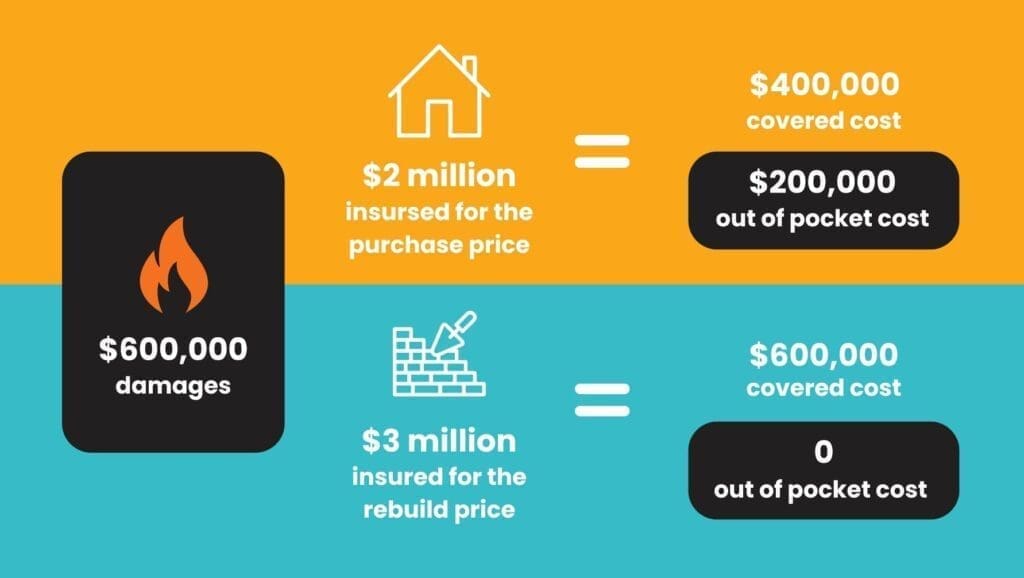
  • A property was purchased for $2 million, but the actual rebuild cost is $3 million
  • The sum insured is set at $2 million (instead of $3 million).
  • A fire causes $600,000 worth of damage
  • Because the building was underinsured by one-third, the insurer may pay only two-thirds of the claim (about $400,000)

This could leave you, the owner, with $200,000 out of pocket expenses even though the damage wasn’t a total loss.

professional property valuations matter to help you determine the right cost to insure your property for

Why professional property valuations matter

Construction costs in Australia have surged in recent years, driven by shortages of materials and skilled labour. Without a proper valuation, it’s easy to underestimate the cost of rebuilding today compared to when you purchased the property. A professional building valuation gives you:

  • Confidence that your sums insured are accurate
  • Protection from co-insurance penalties
  • Peace of mind that your biggest asset is covered correctly

It’s best to arrange a professional building valuation every few years and review your insurance sums annually. That way, your cover keeps pace with any changes to your property, as well as rising rebuild costs and inflation.

Avoid underinsurance with proper valuation

The purchase price reflects market conditions, not rebuilding costs. Having a commercial property is already a significant investment, and underinsurance can create unexpected financial strain during claims. To safeguard your investment, arrange a professional building valuation and review it regularly. That way, your insurance truly reflects today’s replacement costs, not yesterday’s market value.

When it comes to protecting your assets and ensuring the sums are properly accounted for, a Broker would be a huge help. If you want advice or are interested in learning about available options for commercial property coverage, reach out to East West Insurance Brokers today.

Categories
Cyber Insurance

How to navigate rising cyber insurance premiums

Survey after survey, business executives have unanimously agreed to one thing: the risk of a cyber attack as their biggest fear. Reviewing the most recent Allianz Risk Barometer, cyber incidents and business interruption tie as the top concerns of Australian businesses, with over 40% of responses to these risks.

These results come as no surprise to cyber security experts, with cyber crimes becoming increasingly common especially since the pandemic began. At the start of Covid-19, we saw a spike in the number of ransomware attacks against businesses of all sizes. With the continuous evolution and advancement of these ransomware, they are becoming more successful in their attempts to harm organisations, costing businesses billions of dollars every year. With many of us continuing to work remotely in the endemic stage, there are no signs of cybercrimes slowing down.

According to the Australian Cyber Security Centre (ACSC), the 2020/21 financial year saw over 67,500 cybercrime reports made via ReportCyber. In an everyday perspective, one cybercrime is reported approximately every eight minutes in Australia. That’s a staggering increase of nearly 13% from the previous financial year. The average 2017 cyber claim has risen over three times the severity of previous years, with ransomware incidents making up over 30% of claims. With cyber claims on the rise, it is no surprise that insurers are tightening their belts to accommodate the high levels of risk and cost of claims. The result of this will ultimately see the cost of premiums go up as well.

What does this mean for SME business owners?

As insurers are becoming more stringent with their requirements, it is increasingly difficult to get covered against cyber risks. You will need to show insurers that you are taking the necessary (and improved) steps to prevent a compromise to your IT systems. A previous mitigation plan may no longer apply as it could be insufficient to modern malware, and it will be tough to secure an insurer who will be willing to underwrite the risk. For bigger companies with an in-house IT department, preparing an updated mitigation plan may not be an issue. However, for small companies without a dedicated IT security team, this can prove to be a challenge.

Fortunately, there are steps that SMEs can take to meet the strict criteria set out by insurers. Mitigation is key when it comes to cyber security. The help of an experienced insurance broker can help bridge the gap and make it less complicated for small businesses to get covered. Remember, not all cyber policies offer the same level of protection. It can be challenging to determine the best insurance policy for your business. Engaging a broker will not only ease the application process, but they will also advise the steps you need to take to ensure your business continues running smoothly.

At East West Insurance Brokers, we know what the insurers are after. We’ll learn the ins and outs of your business and work with you to create a cyber security plan so you can get a fitting cyber insurance cover for your business. With hackers always at work and cyber attacks occurring more frequently, it’s best to act now before it is too late.

1800 809 132 | he***@******om.au | www.ewib.com.au

Important Note: All insurance policies have exclusions. Please refer to the Product Disclosure Statement or Policy Wording to decide whether an insurance policy meets your needs.

Categories
Business Insurance

6 Common Questions About Commercial Property Insurance

The first step in getting your commercial property insurance sorted is knowing whether you need it or not. The good news is, this is an easy one.

  1. Why do you need commercial property insurance?
  2. What does commercial property insurance cover?
  3. How much does commercial property insurance cost?
  4. What should I consider when buying commercial property insurance?
  5. What should I watch out for with commercial property insurance?
  6. Where should I go from here?

If you own commercial property of any size or type, then you should consider commercial property insurance. We’re talking anything from an office building to an industrial warehouse, from a cold storage facility to a retail space, and beyond.

If you have financed the purchase, renovation, or fitout of your property then you may actually be required to have property insurance to secure your loan. This can also extend to finance for your contents, stock, or machinery.

Likewise, other contracts you have relating to your property or contents will often contain conditions regarding property insurance, so make sure you have a good look over all of your paperwork. Fortunately, this is something an experienced broker can help you with.

Why do you need commercial property insurance?

You may have just found out that you need to consider property cover, let’s look at why it is a critical part of a sound risk management strategy for any commercial property owner.

You obviously purchased (or are purchasing) this property for a reason, and at the end of the day that reason is to generate future income.

Ask yourself the question – if your property is damaged beyond use, could you afford to repair or replace it without insurance? Or even, would you be able to continue to produce income from your business if the worst did happen?

If you answered no, then you need commercial property insurance to protect your business from these situations.

Commercial property insurance is designed to cover you as an owner, and protect you against exposure to the risks of owning property. That said, not every property policy will suit your unique needs, a qualified broker can assist you in finding the best insurance that covers your needs.

What does commercial property insurance cover?

In general, commercial property insurance covers your property and income for damage arising from tangible events. These can include storms, fire, floods, theft, vandalism and more. There are often optional sections of cover you may wish to add on, such as machinery breakdown, electronic equipment, and general property/tools of trade.

There are two main types of commercial property policies: business pack insurance and industrial special risk (ISR). The most notable difference between the two is that an ISR policy covers your property against damage unless an exclusion is specifically made, whereas a business pack only covers defined events, for example, fire or theft.

An ISR policy may sound preferable, however they are usually only available for property with a combined asset value of over $10 million (some insurers will occasionally consider $5 million).

A broker can help you determine which kind of policy is appropriate for your assets and risks and even tailor cover to fit your situation more effectively.

How much does commercial property insurance cost?

As with all insurance, there are a number of factors that will affect the price of your premium. The average cost of commercial property insurance changes based numerous risk factors considered by insurers. These are all worth keeping in mind when purchasing or making changes to your premises.

  • The location of your property
  • The construction of your buildings
  • The security of your premises
  • The fitout of your property
  • The stock held on your property
  • The equipment held on your property
  • The size of your property
  • The age of your buildings
  • The business activities undertaken at your premises

For more information on how these considerations affect your premiums, and what you can do to avoid higher costs, speak to an experienced broker.

Why do you need commercial property insurance?

What should I consider when buying commercial property insurance?

Any insurance policy will only work effectively when it is suited to the specific circumstances it covers. The most important things to consider are: your property’s unique risks and whether the policy covers those, and whether the limit of the policy would be enough to rebuild the premises and your business if you suffered a total loss.

An off-the-shelf commercial property policy is likely to have exclusions that may make it inadequate for your needs, it may also be missing important additions relevant to your unique situation. A full-coverage policy is another option, but it will cost you more.

Price is obviously an important consideration for any business, though be warned that the cheapest policy rarely provides the best coverage. The excess you set will also impact your premiums, but it should be a realistic amount you can afford if the worst does occur.

On that note, underinsurance is becoming a prevalent concern in today’s market. Having a replacement cost valuation completed will help you determine the amount you need to insure your property for. Also, stay vigilant with property market changes and keep your policy up to date if you make any alterations or additions to your premises or if tenancies change.

At the end of the day, the best insurance for commercial property and how much it costs will come down to your individual space and your business’s specific needs. Fortunately, a qualified insurance broker can assist you in determining those.

What should I watch out for with commercial property insurance?

Make sure you gather as much detail about your property and its construction as possible, as insurers will expect full disclosure of anything that is a concern. This could be something common like asbestos, or something less obvious like a specific brand of cladding or machinery that has a higher risk factor.

Remember that commercial property insurance is separate to liability insurance, while there may be some overlap, it is good practice to have both types of cover to protect your business.

A solid piece of general advice is to review all documents as soon as you get them, you should also be provided a certificate of currency that stipulates your cover limits. Continue to revisit them regularly, particularly if you make a change to the building or tenants.

Finally, revisiting the issue of underinsurance, if you are found to have failed to insure your property for a reasonable value you could be held accountable for a percentage of the repair or replacement costs in the event of a loss. Using a qualified insurance valuation expert to make sure your property is insured for an appropriate amount can protect you against this risk.

Where should I go from here?

If you have determined that you may need commercial property insurance, having a broker do the heavy lifting can be a good assurance, and help make the process easier and more efficient. There are a lot of policy wordings to read after all.

At East West Insurance Brokers our team has several decades of combined experience in commercial property insurance, and we are here to assist you through the process of getting your business appropriately covered, and keeping it that way.

From the initial identification of your unique risks, to customising a policy to suit you and your business, you can trust our friendly and knowledgeable insurance advisors to aid you on your journey.

Get in touch today for a commercial property insurance quote tailored to suit you.