Insurers have significantly tightened their underwriting over the past 12 – 18 months, and the level of data required before quoting has increased acrosss the board.
What’s changed?
Insurers are now scrutinising risk information far more closely than they used to. Where a brief overview may have been enough in the past, underwriters today want specifics: detailed claims histories, updated asset values, current risk management practices, workforce numbers, and revenue breakdowns. We are essentially asking for the works.
It’s not about being difficult. It’s about insurers protecting their books in a tougher market.
And here’s the reality: incomplete or vague information leads to higher premiums, coverage restrictions, or declined quotes.
Why we’re asking (again)
We know it can feel repetitive. You provided this information last year, and your business hasn’t changed significantly. Why do we need it all over again?
Because insurers treat every renewal as a fresh underwriting exercise. They’re reassessing your risk profile based on current information, not last year’s data. If we don’t provide comprehensive, accurate details upfront, we lose negotiation power, and potentially you may lose more as a result.
What good information gets you:
Sharper pricing – Underwriters price what they understand. The clearer the picture, the tighter the premium.
Broader coverage – Detailed risk information helps us argue for better terms, higher limits, and fewer exclusions.
Faster turnaround – Complete submissions avoid the back-and-forth that delays quotes and eats into your renewal timeline.
More options – Insurers are more willing to quote and complete when they have confidence in the information.
Our commitment to you
We are not asking for details to tick boxes. We’re asking to secure the best possible outcome for your business. Every data point you provide gives us leverage to negotiate on your behalf, and in this market, that leverage matters.
We also get that you’re busy. If there’s a way we can make the renewal process easier by pre-filling forms, scheduling a quick call instead of lengthy emails, or consolidating requests, please let us know. We’re here to make this work for you, not add to your workload.
What this means for your business
The more detail we have, the harder we can push for competitive terms. It might feel like extra effort now, but it translates directly into better cover and better value when renewal time comes.
As always, if you’ve got questions about what we’re asking for (or why), we’re happy to walk you through it.
When arranging insurance for a commercial property, many owners make a common mistake: using the purchase price as the sum insured.
On the surface, it feels logical. If that’s what you paid for the property, surely that’s what it’s worth? However, the purchase price doesn’t always reflect the actual cost of rebuilding.
Purchase Price vs. Rebuild Value
It’s important to understand the difference between the purchase price and rebuild value when it comes time to insuring your property. Yes, both relate to what your property is worth, but they represent and serve very different things.
Purchase Price
The purchase price of a property represents the total amount paid to acquire it on the market. It’s affected by several factors, which include:
The value of the land.
The property’s location and market demand.
Broader economic conditions at the time of purchase.
None of these is relevant to an insurer if your building is damaged or destroyed. Insurance is about replacing the structure itself, not the land it sits on.
Rebuild Value
The sum insured is generally expected to reflect the full replacement value of the building, which includes:
Demolition and debris removal.
Professional fees (engineers, architects, surveyors).
Current labour and material costs.
Compliance upgrades (to meet today’s building codes).
What’s the difference?
The key difference between purchase price and rebuild value lies in what each represents. The purchase price reflects the property’s market value, including the land, location, and broader economic factors, while the rebuild value focuses solely on the cost to reconstruct the building if it were damaged or destroyed. This includes demolition, debris removal, professional fees, materials, labour, and any upgrades needed to meet current building codes. In short, insurance covers the cost to rebuild, not the market price you paid.
The cost of getting it wrong
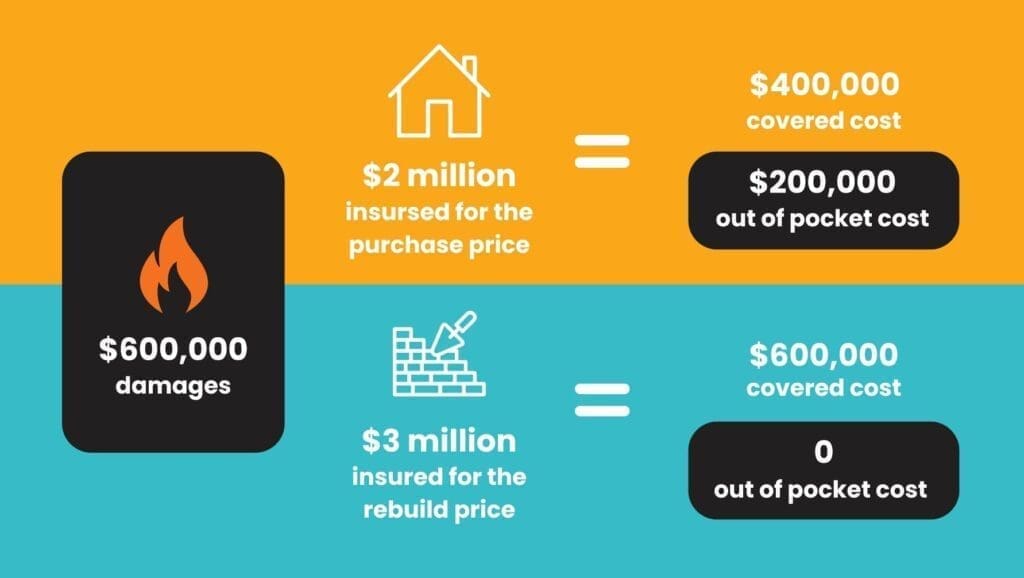
If your sum insured is based on the purchase price rather than a professional valuation, you risk being underinsured. And underinsurance doesn’t just affect you in the event of a total loss. It can also reduce your payout even in the case of a partial claim. For example:
A property was purchased for $2 million, but the actual rebuild cost is $3 million
The sum insured is set at $2 million (instead of $3 million).
A fire causes $600,000 worth of damage
Because the building was underinsured by one-third, the insurer may pay only two-thirds of the claim (about $400,000)
This could leave you, the owner, with $200,000 out of pocket expenses even though the damage wasn’t a total loss.
Why professional property valuations matter
Construction costs in Australia have surged in recent years, driven by shortages of materials and skilled labour. Without a proper valuation, it’s easy to underestimate the cost of rebuilding today compared to when you purchased the property. A professional building valuation gives you:
Confidence that your sums insured are accurate
Protection from co-insurance penalties
Peace of mind that your biggest asset is covered correctly
It’s best to arrange a professional building valuation every few years and review your insurance sums annually. That way, your cover keeps pace with any changes to your property, as well as rising rebuild costs and inflation.
Avoid underinsurance with proper valuation
The purchase price reflects market conditions, not rebuilding costs. Having a commercial property is already a significant investment, and underinsurance can create unexpected financial strain during claims. To safeguard your investment, arrange a professional building valuation and review it regularly. That way, your insurance truly reflects today’s replacement costs, not yesterday’s market value.
When it comes to protecting your assets and ensuring the sums are properly accounted for, a Broker would be a huge help. If you want advice or are interested in learning about available options for commercial property coverage, reach out to East West Insurance Brokers today.
Protect your business with tailored commercial property insurance from our Australian experts. Over 40 years of experience. Get your free quote today!
What do a cozy cafe, a small retail shop, and a towering office building have in common? They all face similar risks when it comes to protecting their property. From fires and floods to theft and vandalism, these unexpected events can disrupt operations—or even force a business to shut down entirely.
That’s why having appropriate commercial property insurance is important. Whether you own or lease your space, your insurance can be the lifeline safeguarding your business from financial fallout.
But before you start insurance shopping, you should first get your commercial property professionally valued.
What is a property valuation?
The estimated market value of a property, which a qualified professional appraiser usually performs. This assessment is based on various factors, which include:
Condition of the property
Existing structures
Location and proximity to other facilities
Market trends
Renovations and upgrades
Size and layout
Valuation of similar properties within the area
There are two main types of property valuations, each serving different purposes. Understanding the distinction between them is crucial to avoid costly mistakes.
Real estate valuation – Used for buying, selling, or securing a mortgage. This type of valuation assesses a property’s sale value, which is influenced by current market trends.
Insurance valuation – Used in insurance applications. It focuses on the cost of rebuilding or repairing a property based on current construction costs.
Insurance valuations are sometimes calculated using a $ per square metre estimate. However, general property valuers may not be qualified to quote rebuild costs. To ensure you’re not underinsured, it’s recommended to consult a surveyor for a more accurate figure.
It’s also important to remember that real estate and insurance valuations can differ significantly, sometimes in millions, and should not be used interchangeably.
How can property valuation impact insurance?
Insurers may use the property valuation report to determine what coverage is necessary and calculate the total cost of the premiums they’ll offer. A higher property value can mean more payouts are required in the event of a repair or replacement claim, leading to higher premiums. On the other hand, they may offer lower premiums to properties with lower value. The catch is this may mean less coverage and more out-of-pocket costs in case of a claim.
You need an accurate property valuation to balance adequate coverage and manageable premiums. This would help you avoid the following:
Over-insuring
Securing as much coverage as possible may sound like the safer option. However, insurers typically don’t pay more than the actual repair cost or the property’s market value. If your property is overvalued, this might lead to over-insuring and paying higher premiums for coverage you may not even need.
Underinsuring
Undervaluing your commercial property to pay lower premiums may sound like an easy way to save money, but it won’t help your business long-term. You may end up exposed to the risk of being underinsured in the event of a claim. Payouts from insurers may not cover enough repair or replacement costs, leading to additional financial strain.
Penalty fees
Policies may include a ‘co-insurance’ clause, which requires the property to be insured to a certain percentage of its value. If your property is found to have been undervalued, your insurance company may penalise you with a penalty fee or reduce the payout in the event of a claim.
Legal issues
An inaccurate commercial property valuation may also violate contractual agreements for leasing and mortgage.
It’s advisable to have your property professionally revalued every few years or whenever significant changes occur, such as renovations, expansions, or shifts in the local market. This helps you and your insurance provider update your coverage to match your business needs.
Having accurate and up-to-date valuation also minimises disputes during claims because insurers are better equipped to assess losses accurately, ensuring a smoother claims process.
Secure your commercial property
Having an accurate and up-to-date property valuation empowers you to make smart financial decisions while ensuring you have adequate insurance coverage to protect your investment. In business, preparation is everything—and staying ahead begins with understanding the true value of what you own.
Want to learn more about commercial property insurance? Connect with East West Insurance Brokers! Our team of expert insurance brokers can provide valuable insights into commercial property coverage for you and your business. Contact us today to get started!
Getting business insurance is essential, but the first step of obtaining a business insurance quote can be very demanding. This process requires you to provide extensive information about your business, not only for assessing and understanding the potential risks your business may face but also for determining the most effective protection strategies and estimating the overall cost of business insurance. But what exactly is required to get an accurate insurance quote?
Provide detailed information about your business to make it easier to assess the level of risk associated with insuring your business and affects the total cost of business insurance. This generally includes the following:
Business Name: The legal name of your business.
Business Address: The physical location of your business.
Industry Type: The industry or sector in which your business operates.
Number of Employees: The total number of employees working for your business.
Annual Revenue: The yearly income generated by your business.
Previous Insurance Coverage: Details of your business’s previous insurance coverage (if any).
2. Assets and Inventory
Another essential piece of information you need to provide is a comprehensive list of current assets and inventory. This should include specifics about the property where your business operates, the equipment utilised in daily operations, and any other assets requiring insurance coverage. The total value of your assets is factored in the calculation of your business insurance quote and can affect what coverage is recommended which leads to the next thing that needs to be assessed.
3. Coverage Needs
Clearly outline your coverage needs when you’re looking for a business insurance quote. By understanding and clearly expressing the specific protections your business requires, you help your insurance provider create a quote that matches your business’s unique needs. This careful preparation not only leads to a more accurate assessment but also ensures that you get the best and most comprehensive coverage.
Here are some examples:
General Liability Insurance – protection against claims of bodily injury or property damage to third parties resulting from business operations.
Property Insurance – covers damage to business property and assets due to events such as fire, theft, vandalism, or natural disasters.
Cyber Liability Insurance – with the increasing threat of cyberattacks and data breaches, businesses need coverage to protect against losses due to hacking, data theft, or other cyber incidents.
Commercial Auto Insurance – if your business owns vehicles or if employees use their vehicles for work purposes, this insurance provides coverage for accidents, injuries, and property damage involving those vehicles. This can be especially useful if employees often travel for work events.
Product Liability Insurance – for businesses that manufacture or sell products, this coverage protects against claims of injury or damage caused by defects in those products.
If you need clarification on what other types of coverage your business will need, contact East West Insurance Brokers. We are here to help you assess your requirements and needs to find the best coverage plan.
4. Claims History
Be ready to provide detailed information about any past insurance claims your business has filed, including the nature of the claims and the amounts paid out. Your business’s claims history is a significant factor in determining the cost of your insurance premiums.
Insurance providers use this history to gauge the risk level of insuring your business. A track record of frequent or high-value claims might indicate higher risk, which could lead to increased premium costs. Accurate and comprehensive details about your claims history help the insurance company provide a fair assessment and pricing for your coverage.
5. Risk Assessment
Factors such as your industry, business operations, location, and safety measures are pivotal in the risk assessment process. Providing detailed and accurate information about these aspects will help ensure that your insurance quote is accurate and tailored to your needs. Many insurance providers include risk assessment services with their policies, offering a convenient option for assessing your business risks. Alternatively, hiring a specialized risk management consultant can provide a more in-depth analysis tailored to your specific industry or business niche.
Conducting your own risk assessment is another viable strategy. Start by identifying potential hazards, vulnerabilities, and threats that could impact your business operations. Also consider external factors from economic conditions, local and global politics, as well as health and environmental issues.
Staying informed through industry publications and news sources is crucial for anticipating and mitigating future risks. There are multiple online resources available to assist businesses in conducting self-assessments and pinpointing potential risks. Being proactive can empower you to better manage and analyse your business’s vulnerabilities.
Looking for a convenient way to get a business insurance quote?
Conducting your own risk assessment to get an estimate cost of business insurance can be time-consuming, particularly when your priority is managing day-to-day business operations. At East West Insurance Brokers, we understand the importance of your time and the complexities of navigating multiple insurance policies. Our team is dedicated to guiding you through the process and identifying the coverage that best suits your needs. Contact our team today to streamline your insurance process and ensure your business is protected.
Agriculture is a cornerstone of Australia’s economy and food security. The industry, however, is vulnerable to climate change, soil degradation, and water scarcity. Weather, pest outbreaks, and market fluctuations also threaten farmers’ financial security. That’s why it’s recommended that farmers get agriculture insurance for financial protection and stability amid environmental uncertainties.
Whether you’re a small-scale farmer or part of a large agricultural operation, considering agriculture insurance is a wise decision, and East West Insurance Brokers is here to help. Our team of expert Insurance Advisers can help you navigate the insurance market and shop around for a good coverage plan. Contact us today to stay protected.
Government agencies and nonprofit organisations alike have implemented initiatives to enhance agricultural productivity while preserving natural resources. Let’s explore a few of these programs and initiatives driving sustainable agriculture in Australia.
Australia’s Net Zero Plan is a bold and ambitious initiative to reduce carbon emissions by 43% by 2030 and achieve net zero emissions by 2050. The plan seeks to achieve these goals through the support of independent and nonprofit organisations, to create a more sustainable and environmentally friendly future for Australia.
But how does this affect the agricultural sector?
Well, the agriculture industry plays a significant role in greenhouse gas emissions (GHG), mainly through livestock production, fertiliser use, and land use changes. They account for 15% of the total emissions in 2019. Meeting net zero targets will require substantial changes in farming practices, potentially impacting productivity, profitability, and livelihoods. Here are the common practices that are being adopted today:
Acceleration of the transition to renewable energy
Planting cover crops to improve soil quality and prevent erosion
Improving fuel efficiency of fishing vessels
Investing in new technology to increase efficiency and reduce waste or raw material consumption
For their part, the Australian Government is developing plans to provide farmers with the necessary education and support to reduce GHG emissions.
Climate-Smart Agriculture Program
The Australian Government established the $300 million Climate-Smart Agriculture Program through the Natural Heritage Trust (NHT). Below is a sample of programs they offer grants to farmers:
Partnerships and Innovation Grants
The program offers grants ranging from $250,000 to $5,000,000 for medium to large-scale projects that promote climate-smart agriculture practices. The application for the first round began on 22 February 2024, and the second round is still being discussed.
Small Grants
Another grant is offered for projects focused on increasing on-farm productivity and sustainable agriculture for community groups. The start date for application is to be announced later this year.
Soil Capacity Building
The Australian Government has invested $21 million in a program that monitors soil quality nationwide. This program aims to gather and assess data about soil trends. Additionally, $6 million has been invested in improving the sharing and use of soil data through the Australian National Information System.
NFF 2030 Roadmap
The National Farmers’ Federation (NFF) spearheaded the development of the NFF 2030 Roadmap, which was developed through a collaborative process that involved more than 300 representatives in the agricultural sector. Created as a strategic blueprint, the 2030 Roadmap identifies key opportunities and challenges in the agricultural sector. Essentially, it’s developed as a guide for growth and sustainability.
The NFF releases annual reports to track progress, maintain accountability, and push continuous innovation for everyone involved. You can access the 2030 Roadmap and its annual reports here.
Australian Agricultural Sustainability Framework
Another initiative by the NFF, with the support of the Australian Government, is the Australian Agricultural Sustainability Framework (AASF). It aims to promote responsible environmental stewardship by upholding ethical practices in compliance with the law, reducing GHG emissions, and preserving the environment. The framework also encourages the development of communities by nurturing the well-being of people and animals.
The AASF started in 2020 and is still in ongoing development. However, you can visit their site to learn more about the initiative.
FutureFeed
Farming, particularly livestock, is a major methane emitter and GHG contributor in Australia. As a solution, the Commonwealth Scientific and Industrial Research Organisation (CSIRO) established the FutureFeed program.
It aims to reduce GHG emissions, boost animal health, and improve farm efficiency with the development of a sustainable feed supplement for livestock using Asparagopsis seaweed.
FutureFeed currently provides licenses for growers and processors rather than selling seaweed directly. If you want to buy the product for your livestock, you can buy from their licensed seaweed growers.
The Future of Sustainable Agriculture
Challenges and triumphs, emphasising innovation, adaptation, and collective action, mark Australia’s journey toward achieving net zero carbon emissions by 2030. The goal, however, extends beyond meeting the deadline. It sets the stage for a sustainable future that preserves Australia’s diverse environment while pushing for innovation and collaboration across all industries. Australia is also contributing to the global fight against climate change for a greener future by adopting transformative technologies and forming eco-partnerships.
FLEXIOriginally launched in the 1980s as a premium funding service helping clients pay insurance premiums in instalments, our platform has evolved to support brokers in offering flexible payment options.
Today, Flexigrow also provides business management software, enabling business owners to manage operations in one streamlined platform. CTA button:VISIT OUR WEBSITE